Big data Updates

Uncover our latest and greatest product updates
blogImage

10 Steps to Setup and Manage a Hadoop Cluster Using Ironfan

Recently, we faced a unique challenge – setup DevOps and management for a relatively complex Hadoop cluster on the Amazon EC2 Cloud. The obvious choice was to use a configuration management tool. Having extensively used Opscode’s Chef and given the flexibility and extensibility Chef provides; it was an obvious choice. While looking around for the best practices to manage a hadoop cluster using Chef, we stumbled upon: Ironfan What is Ironfan? In short Ironfan, open-souced by InfoChimps provides an abstraction on top of Chef, allowing users to easily provision, deploy and manage a cluster of servers – be it a simple web application or a complex Hadoop cluster. After a few experiments, we were convinced that Ironfan was the right thing to use as it simplifies a lot of configuration avoiding repetition while retaining the goodness of Chef. This blog shows how easy it is to setup and manage a Hadoop cluster using Ironfan. Pre-requisties: Chef Account (Hosted or Private) with knife.rb setup correctly on your client machine. Ruby setup (using RVM or otherwise) Installation: Now you can install IronFan on your machine using the steps mentioned here. Once you have all the packages setup correctly, perform these sanity checks: Ensure that the environment variable CHEF_USERNAME is your Chef Server username (unless your USER environment variable is the same as your Chef username) Ensure the the environment variable CHEF_HOMEBASE points to the location which contains the expanded out knife.rb ~/.chef should be a symbolic link to your knife directory in the CHEF_HOMEBASE Your knife/knife.rb file is not modified. Your Chef user PEM file should be in knife/credentials/{username}.pem Your organization’s Chef validator PEM file should be in knife/credentials/{organization}-validator.pem Your knife/credentials/knife-{organization}.rb file Should contain your Chef organization Should contain the chef_server_url Should contain the validation_client_name Should contain path to validation_key Should contain the aws_access_key_id/ aws_secret_access_key Should contain an AMI ID of an AMI you’d like to be able to boot in ec2_image_info Finally in the homebase rename the example_clusters directory to clusters. These are sample clusters than comes with Ironfan. Perform a knife cluster list command : $ knife cluster list Cluster Path: /.../homebase/clusters +----------------+-------------------------------------------------------+ | cluster | path | +----------------+-------------------------------------------------------+ | big_hadoop | /.../homebase/clusters/big_hadoop.rb | | burninator | /.../homebase/clusters/burninator.rb | ... Defining Cluster: Now lets define a cluster. A Cluster in IronFan is defined by a single file which describes all the configurations essential for a cluster. You can customize your cluster spec as follows: Define cloud provider settings Define base roles Define various facets Defining facet specific roles and recipes. Override properties of a particular facet server instance. Defining cloud provider settings: IronFan currently supports AWS and Rackspace Cloud providers. We will take an example of AWS cloud provider. For AWS you can provide config information like: Region, in which the servers will be deployed. Availibility zone to be used. EBS backed or Instance-Store backed servers Base Image(AMIs) to be used to spawn servers Security zone with the allowed port range. Defining Base Roles: You can define the global roles for a cluster. These roles will be applied to all servers unless explicitly overridden for any particular facet or server. All the available roles are defined in $CHEF_HOMEBASE/roles directory. You can create a custom role and use it in your cluster config. Defining Environment: Environments in Chef provide a mechanism for managing different environments such as production, staging, development, and testing, etc with one Chef setup (or one organization on Hosted Chef). With environments, you can specify per environment run lists in roles, per environment cookbook versions, and environment attributes. The available environments can be found in $CHEF_HOMEBASE/environments directory. Custom environments can be created and used. Ironfan.cluster 'my_first_cluster' do # Enviornment under which chef nodes will be placed environment :dev # Global roles for all servers role :systemwide role :ssh # Global ec2 cloud settings cloud(:ec2) do permanent true region 'us-east-1' availability_zones ['us-east-1c', 'us-east-1d'] flavor 't1.micro' backing 'ebs' image_name 'ironfan-natty' chef_client_script 'client.rb' security_group(:ssh).authorize_port_range(22..22) mount_ephemerals end Defining Facets: Facets are group of servers within a cluster. Facets share common attributes and roles. For example, in your cluster you have 2 app servers and 2 database servers then you can group the app servers under the app_server facet and the database servers under the database facet. Defining Facet specific roles and recipes: You can define roles and recipes particular to a facet. Even the global cloud settings can be overridden for a particular facet. facet :master do instances 1 recipe ‘nginx’ cloud(:ec2) do flavor ‘m1.small’ security_group(:web) do authorize_port_range(80..80) authorize_port_range(443..443) role :hadoop_namenode role :hadoop_secondarynn role :hadoop_jobtracker role :hadoop_datanode role :hadoop_tasktracker end facet :worker do instances 2 role :hadoop_datanode role :hadoop_tasktracker end In the above example we have defined a facet for Hadoop master node and a facet for worker node. The number of instances of master is set to 1 and that of worker is set to 2. Each master and worker facets have been assigned a set of roles. For master facet we have overridden the ec2 flavor settings as m1.medium. Also the security group for the master node is set to accept incoming traffic on port 80 and 443. Cluster Management: Now that we are ready with the cluster configuration lets get a hands on cluster management. All the cluster configuration files are placed under the $CHEF_HOMEBASE/clusters directory. We will place our new config file as hadoop_job001_cluster.rb. Now our new cluster should be listed in the cluster list. List Clusters: $ knife cluster list Cluster Path: /.../homebase/clusters +-------------+-------------------------+ | cluster | path | +-------------+-------------------------+ hadoop_job001 HOMEBASE/clusters/hadoop_job001_cluster.rb +-------------+-------------------------+ Show Cluster Configuration: $ knife cluster show hadoop_job001 Inventorying servers in hadoop_job001 cluster, all facets, all servers my_first_cluster: Loading chef my_first_cluster: Loading ec2 my_first_cluster: Reconciling DSL and provider information +-----------------------------+-------+-------------+----------+------------+-----+ | Name | Chef? | State | Flavor | AZ | Env | +-----------------------------+-------+-------------+----------+------------+-----+ | hadoop_job001-master-0 | no | not running | m1.small | us-east-1c | dev | | hadoop_job001-client-0 | no | not running | t1.micro | us-east-1c | dev | | hadoop_job001-client-1 | no | not running | t1.micro | us-east-1c | dev | +-----------------------------+-------+-------------+----------+------------+-----+ Launch Cluster: Launch Whole Cluster: $ knife cluster launch hadoop_job001 Loaded information for 3 computer(s) in cluster my_first_cluster +-----------------------------+-------+---------+----------+------------+-----+------------+--------- -------+----------------+------------+ | Name | Chef? | State | Flavor | AZ | Env | MachineID | Public IP | Private IP | Created On | +-----------------------------+-------+---------+----------+------------+-----+------------+----------------+----------------+------------+ | hadoop_job001-master-0 | yes | running | m1.small | us-east-1c | dev | i-c9e117b5 | 101.23.157.51 | 10.106.57.77 | 2012-12-10 | | hadoop_job001-client-0 | yes | running | t1.micro | us-east-1c | dev | i-cfe117b3 | 101.23.157.52 | 10.106.57.78 | 2012-12-10 | | hadoop_job001-client-1 | yes | running | t1.micro | us-east-1c | dev | i-cbe117b7 | 101.23.157.52 | 10.106.57.79 | 2012-12-10 | +-----------------------------+-------+---------+----------+------------+-----+------------+----------------+----------------+------------+ Launch a single instance of a facet: $ knife cluster launch hadoop_job001 master 0 Launch all instances of a facet: $ knife cluster launch hadoop_job001 worker Stop Whole Cluster: $ knife cluster stop hadoop_job001 Stop a single instance of a facet: $ knife cluster stop hadoop_job001 master 0 Stop all instances of a facet: $ knife cluster stop hadoop_job001 Setting up a Hadoop cluster and managing it cannot get easier than this! Just to re-cap, Ironfan, open-souced by InfoChimps, is a systems provisioning and deployment tool which automates entire systems configuration to enable the entire Big Data stack, including tools for data ingestion, scraping, storage, computation, and monitoring. There is another tool that we are exploring for Hadoop cluster management – Apache Ambari. We will post our findings and comparisons soon, stay tuned!

Aziro Marketing

blogImage

4 AI and Analytics trends to watch for in 2020-2021

Never did we imagine the fictional robotic characters in novellas to become a reality. However, we wished, didn’t we? The theory of ‘Bots equal to Brains’ is now becoming a possibility. The mesmerizing and reverence Artificial Intelligence (AI) that we as children saw in the famous TV show- The Richie Rich has now become a plausible reality. Maybe, we are not fully prepared to leverage AI/Robotics as part of our daily lives; however, it has already created a buzz, profoundly among the technology companies. AI has found a strong foothold in the realms of data analytics and data insights. Companies have started to leverage advanced algorithms garnering actionable insights form a vast set of data for smart customer interactions, better engagement rates, and newer revenue streams. Today, Intelligence-driven Machine Learning intrigues most companies in different industries globally; however, not all exploit its true potentials. Combining AI with Analytics can help us drive intelligent automation delivering enriched customer experiences. Defining AI in Data Analytics This can be broad. However, to summarize, it means using AI in gathering, sorting, analyzing a large chunk of unstructured data, and generating valuable and actionable insights driving quality leads. Big players triggering the storm around AI AI may sound scary or fascinating in the popular imagination; however, some of the global companies have understood its path-breaking impact and invested in it to deliver smart outputs. Many big guns like IBM, Google, and Facebook are at the forefront, driving the AI bandwagon for better human and machine co-ordination. Facebook, for instance, implements advanced algorithms triggering automatic photo tagging options and relevant story suggestions (based on user search, likes, comments, etc.). However, with big players triggering the storm around AI, marketers are slowly realizing the importance of humongous data available online for brand building and acquiring new customers. Hence, we can expect a profound shift towards AI application in Data Analytics in the future. What’s in store for Independent Software Vendors (ISVs) and Enterprise teams With the use of machine learning algorithms, Independent Software Vendors and Enterprise teams can personalize the product offerings using sentimental analysis, voice recognition, or engagement patterns. The application of AI can automate the tasks while giving a fair idea of their expectations and needs. This could help product teams in bringing out innovative ideas. Product specialists can also differentiate between bots and people, prioritize responses based on customers, and identify competitor strategies concerning customer engagements. One of the key elements that AI will gain weight among product marketers will be its advantage in real-time response. The changing business dynamics and customer preferences make it crucial to draft responses in real-time and consolidate customer trust. Leveraging AI will ensure that you, as a brand, are ready to meet customer needs without wasting any time. Let us understand a classic example of how real-time intelligent social media analytics can create new opportunities. Lets read about 4 AI and Analytics trends to watch for in 2020-2021 1. Conversational UI Conversational UI is a step ahead from pre-fed and templated chatbots. Here, you actually make a UI that talks to users with human language. It allows users to tell a computer what it needs. Within conversational UI, there is written communication where you would type in a chatbox and voice assistant that facilitate oral communication. We could see more focus on voice assistants in the future. For example, we are already experiencing a significant improvement in the “social” skills of Crotona, Siri, and OK Google.   2. 3D Intelligent Graphs With the help of data visualization, insights are presented interactively to the users. It helps create logical graphs consisting of key data points. It provides an easy to use dashboard where data can be viewed to reach to the conclusion. It helps quickly grasp the overall pattern, understand the trend, and strike out elements that require attention. Such interactive, 3D graphs are increasingly used by online learning institutes to make learning interactive and fun. You will also see 3D graphs used by data scientists to formulate advanced algorithms. 3. Text Mining It is a form of Natural Language Processing that used AI to study phrases or text and detect underlying value. It helps organizations to segregate information from emails, social media posts, product feedbacks, and others. Businesses can leverage text mining to extract keywords, important topic names, or highlight the sentiment – positive, neutral, or negative. 4. Video and Audio Analytics This will become a new normal in the coming few years. Video Analytics is computer-supported facial recognition, gesture recognition used to get relevant and sensitive information from video and audios to reduce human efforts and enhance security. You can use it in parking assistance, traffic management, access authorization, among others. Can AI get CREEPY? There is a growing concern over breach of privacy by the unethical use of AI. Are the concerns far-fetched? Guess not! It is a known fact that some companies use advanced algorithms to track your details such as phone numbers, anniversaries, addresses, etc. However, some do not limit to the aforementioned data, foraying into our web-history, traveling details, shopping patterns, etc. Imagine your recent picture on Twitter or Facebook, which has a privacy setting activated used by a company to create your bio. This is undoubtedly creepy! Data teams should chalk down key parameters to acquire data and share information with the customers. Even if you have access to individual customer information like their current whereabouts, a favorite restaurant, or favorite team, one should refrain from using it while interacting with customers. It is your wisdom to diligently using customer data without intruding on their privacy. Inference Clearly, the importance of analytics and the use of AI for adding value to the process of data analysis is going up through 2020. With data operating in silos, most organizations are finding it difficult to manage, govern, and extract value out of their unstructured data. This will make them lose on a competitive edge. Therefore, we would experience a rise of data as a service that will instigate the onboarding of specialized data-oriented skills, finely grained business processes, and data-critical functions.

Aziro Marketing

blogImage

8 Steps To Foolproof Your Big Data Testing Cycle

Big Data refers to all the data that is generated across the globe at an unprecedented rate. This data could be either structured or unstructured. Comprehending this information and disentangling the different examples, uncovering the various patterns, and revealing unseen connections within the vast sea of data becomes critical and a massively compensating undertaking in reality. Better data leads to better decision making, and an improved way to strategize for organizations, irrespective of their size. The best ventures of tomorrow will be the ones that can make sense of all data at extremely high volumes and speeds to capture newer markets and client base.Why require Big Data Testing?With the presentation of Big Data, it turns out to be especially vital to test the enormous information framework with the utilization of suitable information accurately. If not tried appropriately, it would influence the business altogether; thus, automation becomes a key part of Big Data Testing. Enormous Data Testing whenever done inaccurately will make it extremely hard to comprehend the blunder, how it happened and the likely arrangement with alleviation steps could take quite a while along these lines bringing about mistaken/missing information, and adjusting it is again a colossal test so that present streaming information isn’t influenced. As information is critical, it is prescribed to have a relevant component with the goal that information isn’t lost/debased and proper mechanism should be used to handle failoversBig Data has certain characteristics and hence is defined using 4Vs, namely:Volume: is the measure of information that organizations can gather. It is huge and consequently, the volume of the information turns into a basic factor in Big Data Analytics.Velocity: the rate at which new information is being created, on account of our reliance on the web, sensors, machine-to-machine information is likewise imperative to parse Big Data conveniently.Variety: the information that is produced is heterogeneous; as in it could be in different types like video, content, database, numeric, sensor data and so on and consequently understanding the kind of Big Data is a key factor to unlocking its potential.Veracity: knowing whether the information that is accessible is originating from a believable source is of most extreme significance before unraveling and executing Big Data for business needs.Here is a concise clarification of how precisely organizations are using Big Data:When Big Data is transformed into pieces of data then it turns out to be quite direct for most business endeavors as it comprehends what their clients need, what items are quick moving, what are the desires for the clients from the client benefit, how to accelerate an opportunity to advertise, approaches to lessen expenses, and strategies to assemble economies of scale in an exceedingly productive way. Thus Big Data distinctively leads to big-time benefits for organizations and hence naturally there is such a huge amount of interest in it from all around the world.Testing Big Data:Source: Guru99.comLet us have a look at the scenarios for which Big Data Testing can be used in the Big Data components: –1. Data Ingestion: –This progression is considered as pre-Hadoop arrange where information is created from different sources and information streams into HDFS. In this progression, the analyzers check that information is removed legitimately and information is stacked into HDFS.Ensure appropriate information from different sources is ingested; for example, every required datum is ingested according to its characterized mapping; and information with non-coordinating pattern is not to be ingested. Information which has not coordinated with diagram ought to be put away for details stating the reason.Comparison of source data with data ingested to simply validate that correct data is pushed.Verify that correct data files are generated and loaded into HDFS correctly into desired location.2. Data Processing: –This progression is utilized for approving Map-Reduce employments. Map-Reduce is a concept used for condensing large amount of data into aggregated data. The information ingested is handled utilizing execution of Map-Reduce employments which gives wanted outcomes. In this progression, the analyzer confirms that ingested data is prepared utilizing Map-Reduce employments and approve whether business rationale is actualized accurately.Data Storage: –This progression is utilized for putting away yield information in HDFS or some other stockpiling framework, (for example, Data Warehouse). In this progression the analyzer checks that yield information is effectively produced and stacked into capacity framework.Validate information is amassed post Map-Reduce Jobs.Verify that right information is stacked into capacity framework and dispose of any middle of the road information which is available.Verify that there is no information defilement by contrasting yield information and HDFS (or any capacity framework) information.The other types of testing scenarios a Big Data Tester can do is: –4. Check whether legitimate ready instruments are actualized, for example, Mail on alarm, sending measurements on Cloud watch and so forth.5. Check whether exceptions or mistakes are shown legitimately with suitable special case message so tackling a blunder turns out to be simple.6. Performance testing to test the distinctive parameters to process an arbitrary lump of vast information and screen parameters, for example, time taken to finish Map-Reduce Jobs, memory use, circle use and different measurements as required.7. Integration testing for testing complete work process specifically from information ingestion to information stockpiling/representation.8. Architecture testing for testing that Hadoop is exceptionally accessible all the time and failover administrations are legitimately executed to guarantee information is handled even if there should arise an occurrence of disappointment of hubs.Data Storage – HDFS (Hadoop Distributed File System), Amazon S3, HBase.Note: – For testing it is very important to generate data that covers various test scenarios (positive and negative). Positive test scenarios cover scenarios which are directly related to the functionality. Negative test scenarios cover scenarios which do not have direct relation with the desired functionality.Tools used in Big Data TestingData Ingestion – Kafka, Zookeeper, Sqoop, Flume, Storm, Amazon Kinesis.Data Processing – Hadoop (Map-Reduce), Cascading, Oozie, Hive, Pig.

Aziro Marketing

blogImage

A Beginner’s Guide to Complete Analysis of Apache Spark RDDs and Java 8 Streams

1. What is Apache Spark RDD? Apache Spark RDD stands for Resilient Distributed Datasets. RDD is a fault tolerant, immutable collection of elements which can be operated on, in parallel. We can perform various parallel operations on them such as map, reduce, filter, count, distinct etc. We can persist them in local memory and perform these operations on them. RDDs can be created in two ways: A. parallelize(): calling a parallelize method on the existing collection in our program (pass collection object to the method). JavaRDD javaRDD = sparkContext.parallelize(Arrays.asList(1, 2, 3, 4, 5)); B. textFile(): calling textFile method by passing the path of the file at local or shared file system (pass file URI to the method). JavaRDD lines = sparkContext.textFile("URI/to/sample/file.txt"); Both methods are called using the reference of JavaSparkContext class. There are two types of operations that can be performed on RDDs: Transformations: which perform some operations on RDD to return an RDD (map). Actions: which return a value after performing the operation (reduce). Consider the following example of map and reduce to calculate the total length of the lines in the file, using JavaRDDs: JavaRDD lines = sc.textFile("URI/to/sample/file.txt"); JavaRDD lengths = lines.map(l -> l.length()); int totalLength = lengths.reduce((a, b) -> a + b); 2. What is Java 8 Streams API? Java Stream API sounds similar to InputStream and OutputSream in Java IO, but it is completely different, so let’s not get confused. Streams are specifically introduced in Java 8 to ease functional programming. Java Streams are Monads, a structure that represents computations as a chain of steps. Streams are the Java APIs that let you manipulate the collections. You can chain together multiple Stream operations to achieve a complex data processing pipeline. With Streams API, you can write the code that’s Declarative: More concise as well as readable Composable: Greater flexibility Parallelizable: Better performance (using Parallel Streams) Streams can also be created the same way as Spark RDDs A. Collections as well as Arrays: List strings = Arrays.asList("abc", "", "bc", "efg", "abcd","", "jkl"); //get count of empty string int count = strings.parallelStream().filter(string -> string.isEmpty()).count(); B. File Systems: Stream stream = Files.lines(Paths.get("URI/to/sample/file.txt"); Like RDDs Streams, operations are also of two types: Intermediate (like Transformations): which performs some operations on Stream to return a Stream (map). Terminal: which returns a value after performing the operation or can be void (reduce, foreach). Stream lines = Files.lines(Paths.get("URI/to/sample/file.txt"); Stream lineLengths = lines.map(s -> s.length()); int totalLength = lineLengths.reduce(0, (a, b) -> a + b); Streams accept Lambda Expression as a parameter, which is a functional interface that specifies the exact behavior of the operation. The intermediate operations are executed only when the terminal operation is called over them. Once a terminal operation is called over a Stream, we cannot reuse it. If we want to use any intermediate operation of a Stream, we have to create a Stream Supplier which constructs a new Stream with the intermediate operations. The supplier provides get() method to fetch the desired intermediate Stream operation that is already saved. 3. What Can We Do with Spark RDD? To perform very fast computations over a shared data set such as iterative distributed computing, we need to have an excellent data sharing architecture. This involves processing data using multiple ad-hoc queries and sharing and reusing of data among multiple jobs. To perform these operations, we need to have a mechanism that stores the intermediate data over a distributed data store which may lead to slower processing due to multiple IO operations. RDDs help us do such operations by breaking the computations into small tasks which run on separate machines. We can cache these RDDs into our local discs to use them in other actions. This helps to execute the future actions much faster. persist() or cache() methods help us keep the computed RDDs in the memory of the nodes. Following properties make RDDs perform best for iterative distributed computing algorithms like K-means clustering, page rank, Logistic regression etc: Immutable Partitioned Fault tolerant Created by coarse grained operations Lazily evaluated Can be persisted More importantly, all the Transformations in RDDs are lazy, which means their result is not calculated right away. The results are just remembered and are computed just when they are actually needed by the driver program. The Actions, on the other hand are eager. 4. What Can We Do with Java 8 Streams API? Stream APIs (and of course Lambdas) were introduced in Java 8 considering parallelism as the main driving force. Streams help to write the complex code in concise way which is more readable, flexible and understandable. Streams can be created from various data sources, like Collections, Arrays, and file resources. Streams are of two types: Sequential and Parallel Streams. We can perform distributed computing operations using multiple threads using Streams. Parallel Streams can be used to boost the performance of Streams when there is a large amount of input data. Like RDDs, we have methods like map, reduce, collect, flatMap, sort, filter, min, max, count etc. in Streams. Consider a list of fruits: List fruits = Arrays.asList("apple", "orange", "pineapple", "grape", "banana", "mango", “blackberry”); Filter() fruits.filter( fruit -> fruit.startsWith("b") ); Map() fruits.map( fruit -> fruit.toUpperCase() ) Collect() List filteredFruits = fruits.filter( fruit -> fruit.startsWith("b") ) .collect(Collectors.toList()); Min() and Max() String shortest = fruits.min(Comparator.comparing(fruit -> fruit.length())).get(); Count() long count = fruits.filter( fruit -> fruit.startsWith("b")).count(); Reduce() String reduced = fruits.filter( item -> item.startsWith("b")) .reduce("", (acc, item) -> acc + " " + item); 5. How Are They Same? RDDs and Streams can be created the same way: from Collections and File Systems. RDDs and Streams perform two (same) types of operations: Transformations in RDDs == Intermediate in Streams Actions in RDDs == Terminal in Streams Transformations (RDDs) and Intermediate (Streams) have the same important characteristic i.e. Laziness. They just remember the transformations instead of computing them unless an Action is needed.While Actions (RDDs) and Terminal (Streams) operations are eager Operations. RDDs and Streams help in reducing the actual number of operations performed over each element as both use Filters and Predicates. Developers can write much concise code using RDDs and Streams. RDDs and (parallel) Streams are used for parallel distributed operations where a large number of data processing is required. Both RDDs and Streams work on the principle of Functional Programming and use lambda Expressions as parameters. 6. How Are They Different? Unlike RDDs, Java 8 Streams are of two types: Sequential and Parallel. Parallelization is just a matter of calling parallel() method in Streams. It internally utilizes the Thread Pool in JVM, while Spark RDDs can be distributed and deployed over a cluster. While Spark has different storage levels for different purposes, Streams are in memory data structures. When you call parallelize method in Streams, your data is split into multiple chunks and they are processed independently. This process is CPU intensive and utilizes all the available CPUs. The Java parallel Streams use a common ForkJoinPool. The capacity of this ThreadPool to use Threads depends on the number of available CPU cores. This value can be increased or decreased using the following JVM parameter, -Djava.util.concurrent.ForkJoinPool.common.parallelism=5 So for executing the parallel Stream operations the Stream utilizes all the available threads in the ThreadPool. Moreover, if you submit a long running task, this could result in blocking all the other threads in the ThreadPool. One long task could result into blocking of entire application. 7. Which One Is Better? When? Though RDDs and Streams provide quite similar type of implementations, APIs and functionalities, Apache Spark is much more powerful than Java 8 Streams. While it’s completely our choice what to use when, we should always try to analyze our requirements and proceed for the implementations. As parallel Streams use a Common Thread Pool, we must ensure that there won’t be any long running task which will cause other threads to stuck. Apache Spark RDDs will help you distribute the data over cluster. When there are such complex situations which involve a real huge amount of data and computations, we should avoid using Java 8 Streams. So for non-distributed parallel processing my choice would be to go with Streams, while Apache Spark RDDs would be preferable for real time analytics or continuously streaming data over distributed environments.

Aziro Marketing

blogImage

Advanced Log Analytics for Better IT Management

Aziro (formerly MSys Technologies) Advanced Log AnalyticsAziro (formerly MSys Technologies)’ lab is developing a Log Analytics tool which will collect logs, store the logs and do the analytics on the log data. The Log Analytics tool will be part of “Total Digital Transformation” application. The “Total Digital transformation” is achieved through Dev-Ops, Continuous Integration, Continuous Delivery and Analytics. Log Analytics will ensure Digital Transformation is successful and effective.Today Devops has transformed IT operations and IT Deployment. Now Analytics will transform DevOps and IT operations. DevOps – with Big Data analytics and machine learning key components of a successful IT operations. IT Managers and IT System admins will use powerful analytics and deeper insights at their fingertips to make effective business decisions.Need for Log AnalyticsOne of the biggest hurdles in restoring service for a crashed application is to wade through the log files and identify the reason(s) for application failure.Today many applications are getting deployed on many servers and in shorter time. The task of managing these applications and IT infrastructure is becoming complex and time-consuming. In case of business critical applications, any application down time results in loss of business and results in many escalations. Now it is possible to implement an analytics solution that can help in reducing the time needed to identify problems as and when they occur.Initially, the Log Analytics will be used to raise alerts, sending email and/or creating tickets. The next step is to create a Log Analytic solution that can predict, with confidence, the occurrence of events of significance. Finally Log Analytics will have Predictive Analytics that has ability to identify and predict failures before they occur.Advanced Log Analytics for Better IT ManagementAziro (formerly MSys Technologies) has deep expertise in Log Analytics capabilities. Mys is building a Log Analytics using ELK stack of tools, where E stands for Elasticsearch, L stands for Logstash (log parser) and K stands for Kibana (visualization).Elasticsearch, an open-source search engine is built on top of Apache Lucene™. It is a full-text search-engine library. Lucene is a complex, advanced, high-performance, and fully featured search engine library. Elasticsearch uses Lucene internally for all of its indexing and searching, but aims to make full-text search easy by hiding Lucene’s complexities behind a simple, coherent, RESTful API. Elasticsearch also supports the following features.ELK :A distributed real-time document store where every field is indexed and searchableA distributed search engine with real-time analyticsIt is capable of scaling to hundreds of servers and petabytes of structured and unstructured data

Aziro Marketing

blogImage

Big Data and Your Privacy: How Concerned Should You Really Be?

Today, every IT-related service online or offline is driven by data. In the last few years alone, explosion of social media has given rise to a humongous amount of data, which is sort of impossible to manipulate without specific high-end computing systems. In general, normal people like us are familiar with kilobytes, megabytes, and gigabytes of data, some even terabytes of data. But when it comes to the Internet, data is measured in entirely different scales. There are petabytes, exabytes, zettabytes, and yottabytes. A petabyte is a million gigabyte, an exabyte is a billion gigabyte, and so on.A Few Interesting StatisticsLet me pique your interest with a few statistics here from various sources: 90 percent of data in existence in the world was created in the last two years alone.90 percent of data in existence in the world was created in the last two years alone.The reason why Amazon sells five times Wal-Mart, Target, and Buy.com combined is because the company steadily grew to be of 74 billion dollar revenue from a miniature bookseller by incorporating all the statistical customer data it gathered since 1994. In a week, Amazon targets close to 130 million customers—imagine the enormous amount of big data it can gather from them.Google’s former CEO and current executive chairman, Eric Schmidt, once said: “If you have something that you don’t want anyone to know, maybe you shouldn’t be doing it in the first place.” The significance of this statement is evident when you realize the magnitude of data that the search giant crunches every second. In its expansive index, Google has stored anywhere between 15 to 20 billion web pages, as in this statistic.On a daily basis, Google processes five billion queries. Beyond these, through numerous Google apps that you continuously use, such as Gmail, Maps, Android, Google+, Places, Blogger, News, YouTube, Play, Drive, Calendar, etc., Google is collecting data about you on a huge scale.All of this data is known in the industry circles as “big data.” Processing such huge chunks of data is not really possible with your existing hardware and software. That’s the reason why there are industry-standard algorithms for the purpose. Apache Hadoop, which Google also uses, is one such system. Various components of Hadoop–HDFS, MapReduce, YARN, etc.–are capable of intense data manipulation and processing capabilities. Similar to Hadoop, Apache Storm is a big data processing technology used by Twitter, Groupon, and Alibaba (the largest online retailer in the world).The effects and business benefits of big data can be quite significant. Imagine the growth of Amazon in the last few years. In that ginormous article, George Packer gives a “brief” account of Amazon’s growth in the past few years: from “the largest” bookseller to the multi-product online-retail behemoth it is today. What made that happen? In essence, the question is what makes the internet giants they are today? Companies such as Facebook, Google, Amazon, Microsoft, Apple, Twitter, etc., have reached the position they are today by systematically processing the big data generated by their users–including you.In essence, data processing is an essential tool for success in today’s Internet. How is the processing of your data affecting your privacy? Some of these internet giants gather and process more data than all governments combined. There really is a concern for your privacy, isn’t there?Look at National Security Agency of the US. It’s estimated that NSA has a tap on every smartphone communication that happens across the world, through any company that has been established in the United States. NSA is the new CIA, at least in the world of technology. Remember about PRISM program that the NSA contractor Edward Snowden blew the whistle on. For six years, PRISM remained under cover; now we know the extent of data collected by this program is several times in magnitude in comparison to the data collected by any technology company. Not only that, NSA, as reported by the Washington Post, has a surveillance system that can record hundred percent of telephone calls from any country, not only the United States. Also, NSA allegedly has the capability to remotely install a spy app (known as Dropoutjeep) in all iPhones. The spy app can then activate iPhone’s camera and microphone to gather real-time intelligence about the owner’s conversations. An independent security analyst and hacker Jacob Appelbaum reported this capability of the NSA.NSA gets a recording of every activity you do online: telephone and VoIP conversations, browsing history, messages, email, online purchases, etc. In essence, this big data collection is the biggest breach of personal privacy in human history. While the government assures that the entire process is for national security, there are definitely concerns from the general public.Privacy ConcernsWhile on one side companies are using your data to grow their profit, governments are using this big data to further surveillance. In a nutshell, this could all mean one thing: no privacy for the average individual. As far back as 2001, industry analyst Doug Laney signified big data with three v’s: volume, velocity, and variety. Volume for the vastness of the data that comes from the peoples of the world (which we saw earlier); velocity to mean the breathtaking speeds it takes for the data to arrive; and variety to mean the sizeable metadata used to categorize the raw data.What real danger is there in sharing your data with the world? For one thing, if you are strongly concerned about your own privacy, you shouldn’t be doing anything online or over your phone. While sharing your data can help companies like Google, Facebook, and Microsoft show you relevant ads (while increasing their advertising revenues), there virtually is no downside for you. The sizeable data generated by your activities goes into a processing phase wherein it is amalgamated to the big data generated by other users like you. It’s hence in many ways similar to disappearing in a crowd, something people like us do in the real world on a daily basis.However, online, there is always a trace that goes back to you, through your country’s internet gateway, your specific ISP, and your computer’s specific IP address (attached to a timestamp if you have dynamic IP). So, it’s entirely possible to create a log of all activities you do online. Facebook and Google already have a log, a thing you call your “timeline.” Now, the timeline is a simple representation of your activities online, attached to a social media profile, but with a trace on your computer’s web access, the data generated is pretty much your life’s log. Then it becomes sort of scary.You are under trace not only while you are in front of your computer but also when you move around with your smartphone. The phone can virtually be tapped to get every bit of your conversations, and its hardware components–camera, GPS, and microphone–can be used to trace your every movement.When it comes to online security, the choice is between your privacy and better services. If you divulge your information, companies will be able to provide you with some useful ads of the products that you may really like (and act God on your life!). On the other hand, there is always an inner fear that you are being watched–your every movement. To avoid it, you may have to do things you want to keep secret offline, not nearby any connected digital device–in essence, any device that has a power source attached.In an article that I happened to read some time back, it was mentioned that the only way to bypass security surveillance is removing a battery from your smartphone.The question remains, how you can trust any technology. I mean, there are a huge number of surveillance technologies and projects that people don’t know about even now. With PRISM, we came to know about NSA’s tactics, although most of them are an open secret. Which other countries engage in such tactics is still unknown.

Aziro Marketing

blogImage

Icinga Eyes for Big Data Pipelines: Explained in Detailed

In the plethora of monitoring tools, ranging from open source to paid, it is always a difficult choice to decide which one to go for. This problem becomes more difficult when types of entities which are to be monitored are large and the ways of monitoring are diverse. The various possible entities which are monitored range from low level devices like switches, routers to physical and virtual machines to Citrix XenApp and XenDesktop environments. Some of the available ways of monitoring can be SNMP, JMX, SSH, Netflow, WMI and RRD metrics depending on the device which we want to keep an eye on.With the “ * as code ” terminology coming into the software industry, people have started moving their deployments and configurations as code blocks which are easy to scale, flexible for changes and effortless to maintain. Infrastructure monitoring wasn’t able to keep itself unaffected from this paradigm and evolution of “Monitoring as a Code” came into existence. Icinga is one such tool.Icinga was a fork of Nagios, which is a pioneer in network monitoring, but Icinga has diverged itself into Icinga2 and added various performance and clustering capabilities. Synchronizing with its name “Icinga”, which means ‘it looks for’ or ‘it examines’, is one of the best open source tools available for monitoring of wide variety of devices. Installation is pretty straightforward and requires installing icinga2 package on both master and clients.( yum install icinga2 )All communications between Icinga2 master and clients are secure. On running the node wizard the CSR is generated and for auto signing it, a ticket is required which is obtained by running pki ticket command on client. Icinga Master setup will also require installing and configuring icingaweb2, which provides an appealing monitoring dashboard.( icinga2 node wizard, icinga2 pki ticket –cn )Figure 1: Pluggable ArchitectureMonitoring tools like Icinga follow a pluggable architecture(Figure 1). The tool acts like a core framework in which plugins are glued for enhancing capabilities of core by expanding its functionalities. Installing a plugin for an application gives Icinga ability to monitor the metrics for that specific application. Because of this pluggable architecture, these tools are able to satisfy monitoring requirements of myriad of possible applications. For instance, Icinga have plugins for Graphite and Grafana for showing the graphs for various metrics. On the other hand, it also has integrations with Incident Management tools like OpsGenie and Pagerduty. Basic plugins for monitoring could be installed using:yum install nagios-plugins-alIcinga2 Distributed Monitoring in high availability clustered arrangement can be visualized from Figure 2. Clients run their preconfigured checks or get commands execution events from master/satellite. Master is at core of monitoring and provides icingaweb2 UI. Satellite is similar to master and can run even if master is down and can update master when it is available again. This prevents monitoring outage for entire infrastructure in case of unavailability of master temporarily.Figure 2: Icinga2 Distributed Monitoring with HATypical big data pipeline consists of data producers, messaging systems, analyzers, storage and user interface.Figure 3: Typical Big Data PipelineMonitoring any big data pipeline can be bifurcated mainly into two fields: system metrics and application metrics where metrics is nothing but any entity which varies over time. System metrics comprises of information about CPU, disk and memory i.e. health of a host on which one of the Big Data element is running. Whereas application metrics dives into specific parameters of an application which helps in weighing its performance. Most of the applications can be monitored remotely as they are reachable over REST or JMX. These applications need not install Icinga client for monitoring application metrics. But for system metrics and monitoring those application which do not fall in JMX/REST category, client installation is required.Everything is an object in Icinga; be it a command, a host or a service. Kafka and Spark expose JMX metrics. They can be monitored, using check_jmx command. Let’s consider an example of monitoring a spark metric. The configurations would look like this.object Host "spark" {  import "generic-host"  address = "A.B.C.D" } object CheckCommand "check_jmx" {  import "plugin-check-command"  command = [ PluginDir + "/check_jmx" ]  arguments = {    "-U" = "$service_url$"    "-O" = "$object_name$"    "-A" = "$attrib_name$"    "-K" = "$comp_key$"    "-w" = "$warn$"    "-c" = "$crit$"    "-o" = "$operat_name$"    "--username" = "$username$"    "--password" = "$password$"    "-u" = "$unit$"    "-v" = "$verbose$"  } } apply Service "spark_alive_workers" {  import "generic-service"  check_command = "check_jmx"  vars.service_url = "service:jmx:rmi:///jndi/rmi://" + host.address + ":10105/jmxrmi"  vars.object_name = "metrics:name=master.aliveWorkers"  vars.attrib_name = "Value"’  assign where host.address }The Icinga folder hierarchy inside parent directory is not specific (/etc/icinga2/conf.d) and could be steered according to our requirements and convenience. But all *.conf files are read and processed. Elasticsearch gives REST access. Adding objects and services similar to the above example and changing the command to check_http (and related changes), we will be able to monitor ES cluster’s health. The command which will be fired at every tuned interval will look something like this.check_http -H A.B.C.D -u /_cluster/health -p 9200 -w 2 -c 3 -s greenSimilarly, Icinga/ Nagios plugins are available for various NoSQL databases (MongoDB).These configurations look very daunting and they become more threatening when one has to deal with large number of hosts that are also running variety of applications. That’s where Icinga2 Director comes handy. It provides an abstraction layer in which creating templates for commands, services and hosts are possible from UI and then those templates could be applied to hosts easily. In the absence of Director, configurations need to be manually done on each client which is to be monitored. Director offers a top down approach, i.e. by changing service template for a new service and just clicking deploy configuration, it enables new service at all hosts without incurring the trouble of going to every node.

Aziro Marketing

blogImage

Is there an Alternative for Hadoop ?

HadoopUsing big data technologies for your business is a really an attractive thing and Hadoop makes it even more appealing nowadays. Hadoop is a massively scalable data storage platform that is used as a foundation for many big data projects. Hadoop is powerful, however it has a steep learning curve in terms of time and other resources. It can be a game changer for companies if Hadoop is being applied the right way. Hadoop will be around for a longer time and for good reason as Hadoop can solve even fewer problems.For large corporations that routinely crunch large amounts of data using MapReduce, Hadoop is still a great choice. For research, experimentation, everyday data mugging.Apache Hadoop, the open-source framework for storing and analyzing big data, will be embraced by analytics vendors over the next two years as organizations seek out new ways to derive value from their unstructured data, according to a new research report from Gartner.Few alternatives of HadoopAs a matter of fact, there are many ways to store data in a structured way which stand as an Alternative for Hadoop namely BashReduce, Disco Project, Spark, GraphLab and the list goes on. Each one of them is unique in their own way. If GraphLab was developed and designed for use in machine learning which is focused to make the design and implementation of efficient and correct parallel machine learning algorithms easier, then Spark is one of the newest players in the MapReduce field which stands as a purpose to make data analytics fast to write and run.Conclusion:Despite all these Alternatives, Why Hadoop?One word: HDFS. For a moment, assume you could bring all of your files and data with you everywhere you go. No matter what system, or type of system, you log in to, your data is intact waiting for you. Suppose you find a cool picture on the Internet. You save it directly to your file store and it goes everywhere you go. HDFS gives users the ability to dump very large data sets (usually log files) to this distributed file system and easily access it with tools, namely Hadoop. Not only does HDFS store a large amount of data, it is fault tolerant. Losing a disk, or a machine, typically does not spell disaster for your data. HDFS has become a reliable way to store data and share it with other open-source data analysis tools. Spark can read data from HDFS, but if you would rather stick with Hadoop, you can try to spice it up.Below trend shows the percent of Hadoop adoption:Research firm projects that 65 percent of all “packaged analytic applications with advanced analytics” capabilities will come prepackaged with the Hadoop framework by 2015. The spike in Hadoop adoption largely will be spurred by an organizations’ need to analyze the massive amounts of unstructured data being produced from nontraditional data sources such as social media. Source: Gartner“It doesn’t take a clairvoyant — or in this case, a research analyst — to see that ‘big data’ is becoming (if it isn’t already, perhaps) a major buzzword in security circles. Much of the securing of big data will need to be handled by thoroughly understanding the data and its usage patterns. Having the ability to identify, control access to, and — where possible — mask sensitive data in big data environments based on policy is an important part of the overall approach.”Ramon KrikkenResearch VP, Security and Risk Management Strategies Analyst at Gartner“Hadoop is not a single entity, it’s a conglomeration of multiple projects, each addressing a certain niche within the Hadoop ecosystem such as data access, data integration, DBMS, system management, reporting, analytics, data exploration and much, much more,” – Forrester analyst Boris Evelson.Forrester Research, Inc. views Hadoop as “the open source heart of Big Data”, regarding it as “the nucleus of the next-generation EDW [enterprise data warehouse] in the cloud,” and has published its first ever The Forrester Wave: Initiative Hadoop Solutions report (February 2, 2012).Hadoop Streaming is an easy way to avoid the monolith of Vanilla Hadoop without leaving HDFS, and allows the user to write map and reduce functions in any language that supports writing to stdout, and reading from stdin. Choosing a simple language such as Python for Streaming allows the user to focus more on writing code that processes data rather than software engineering.The bottom line is that Hadoop is the future of the cloud EDW. Its footprint in companies’ core EDW architectures is likely to keep growing throughout this decade. The roles that Hadoop is likely to assume in EDW strategy are the dominant applications.So? What is your experience with big data? Please share with us in the comments section.

Aziro Marketing

blogImage

Data Observability vs Data Quality: Understanding the Differences and Importance

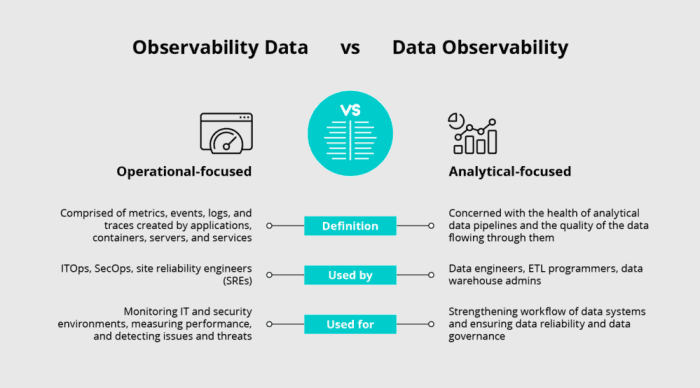
In today’s data-driven world, businesses heavily rely on data to make informed decisions, optimize operations, and drive growth. However, ensuring the reliability and usability of this data is not straightforward. Two crucial concepts that come into play here are data observability and data quality. Although they share some similarities, they serve different purposes and address distinct aspects of data management. This article delves into the differences and importance of data observability vs. data quality, highlighting how both practices work together to ensure data integrity and reliability, offering a comprehensive understanding of both.Source: CriblWhat is Data Observability?Source: acceldataData observability refers to the ability to fully understand and monitor the health and performance of data systems. It includes understanding data lineage, which helps track data flow, behavior, and characteristics. It involves monitoring and analyzing data flows, detecting anomalies, and gaining insights into the root causes of issues. Data observability provides a holistic view of the entire data ecosystem, enabling organizations to ensure their data pipelines function as expected.Key Components of Data ObservabilitySource: TechTargetUnderstanding the critical components of data observability is essential for grasping how it contributes to the overall health of data systems. These components enable organizations to gain deep insights into their data operations, identify issues swiftly, and ensure the continuous delivery of reliable data. Root cause analysis is a critical component of data observability, helping to identify the reasons behind inaccuracies, inconsistencies, and anomalies in data streams and processes. The following paragraphs explain each element in detail and highlight its significance.Monitoring and Metrics in Data PipelinesMonitoring and metrics form the backbone of data observability by continuously tracking the performance of data pipelines. Through real-time monitoring, organizations can measure various aspects such as throughput, latency, and error rates. These metrics provide valuable insights into the pipeline’s efficiency and identify bottlenecks or areas where performance may deteriorate.Monitoring tools help set thresholds and generate alerts when metrics deviate from the norm, enabling proactive issue resolution before they escalate into significant problems. Data validation enforces predefined rules and constraints to guarantee data conforms to expectations, preventing downstream errors and ensuring data integrity.TracingTracing allows organizations to follow data elements through different data pipeline stages. By mapping the journey of data from its source to its destination, tracing helps pinpoint where issues occur and understand their impact on the overall process. Tracing is an integral part of data management processes, helping refine and improve how organizations manage their data.For example, tracing can reveal whether the problem originated from a specific data source, transformation, or storage layer if data corruption is detected at a particular stage. This granular insight is invaluable for diagnosing problems and optimizing data workflows.LoggingLogging captures detailed records of data processing activities, providing a rich source of information for troubleshooting and debugging. Logs document events, errors, transactions, and other relevant details within the data pipeline.By analyzing logs, data engineers can identify patterns, trace the origins of issues, and understand the context in which they occurred. Effective logging practices ensure that all critical events are captured, making maintaining transparency and accountability in data operations easier. Data profiling involves analyzing datasets to uncover patterns, distributions, anomalies, and potential issues, aiding in effective data cleansing and ensuring data adheres to defined standards.AlertingAlerting involves setting up notifications to inform stakeholders when anomalies or deviations from expected behavior are detected in the data pipeline. Alerts can be configured based on predefined thresholds or anomaly detection algorithms. For instance, an alert could be triggered if data latency exceeds a specific limit or error rates spike unexpectedly.Timely alerts enable rapid response to potential issues, minimizing their impact on downstream processes and ensuring that data consumers receive accurate and timely information. Alerting helps proactively identify and resolve data quality issues, ensuring accuracy, completeness, and consistency.What is Data Quality?Source: AlationData quality, on the other hand, focuses on the attributes that make data fit for its intended use. High-quality data is accurate, complete, consistent, timely, and relevant. Data quality involves processes and measures to cleanse, validate, and enrich data, making it reliable and valid for analysis and decision-making.Data quality and observability are both crucial for ensuring data reliability and accuracy, focusing on real-time monitoring, proactive issue detection, and understanding data health and performance.Key Dimensions of Data QualityIn data management, several key attributes determine the quality and effectiveness of data. Attributes such as accuracy, completeness, consistency, timeliness, and relevance ensure that data accurately reflects real-world entities, supports informed decision-making, and aligns with business objectives.AccuracyAccuracy is the degree to which data correctly represents the real-world entities it describes. Inaccurate data can lead to erroneous conclusions and misguided business decisions. Ensuring accuracy involves rigorous validation processes that compare data against known standards or sources of truth.For example, verifying customer addresses against official postal data can help maintain accurate records. High accuracy enhances the credibility of data and ensures that analyses and reports based on this data are reliable.CompletenessCompleteness refers to the extent to which all required data is available, and none is missing. Incomplete data can obscure critical insights and lead to gaps in analysis. Organizations must implement data collection practices that ensure all necessary fields are populated, and no vital information is overlooked.For instance, ensuring that all customer profiles contain mandatory details like contact information and purchase history is essential for comprehensive analysis. Complete data sets enable more thorough and meaningful interpretations.ConsistencyConsistency ensures uniformity of data across different datasets and systems. Inconsistent data can arise from discrepancies in data formats, definitions, or values used across various sources. Standardizing data entry protocols and implementing data integration solutions can help maintain consistency.For example, using a centralized data dictionary to define key terms and formats ensures that all departments interpret data uniformly. Consistent data enhances comparability and reduces misunderstandings.TimelinessTimeliness means that data is up-to-date and available when needed. Outdated data can lead to missed opportunities and incorrect assessments. Organizations should establish processes for regular data updates and synchronization to ensure timeliness.For instance, real-time data feeds from transaction systems can keep financial dashboards current. Timely data enables prompt decision-making and responsiveness to changing circumstances.RelevanceRelevance ensures that data is pertinent to the context and purpose for which it is used. Irrelevant data can clutter analysis and dilute focus. Organizations must align data collection and maintenance efforts with specific business objectives to ensure relevance.For example, collecting data on user interactions with a website can inform targeted marketing strategies. Relevant data supports precise and actionable insights, enhancing the value derived from data analysis.Data Observability vs. Data Quality: Key DifferencesSource: DQOpsQuality and data observability safeguard data-driven decisions, maintain data integrity, and address real-time issues. Here is a list of the key differences between the two:1. ScopeThe scope of data observability focuses on monitoring and understanding the data ecosystem’s health and performance. It encompasses the entire data pipeline, from ingestion to delivery, and ensures that all components function cohesively.Data quality, however, is concerned with the intrinsic attributes of the data itself, aiming to enhance its fitness for purpose. While observability tracks the operational state of data systems, quality measures assess the data’s suitability for analysis and decision-making.2. ApproachThe approach to achieving data observability involves monitoring, tracing, logging, and alerting. These methods provide real-time visibility into data processes, enabling quick identification and resolution of issues. Data quality enhances data attributes using cleansing, validation, and enrichment processes.It involves applying rules and standards to improve data accuracy, completeness, consistency, timeliness, and relevance. While observability ensures smooth data flow, quality management ensures the data is valuable and trustworthy. Implementing data quality and observability practices involves systematic and strategic steps, including data profiling, cleansing, validation, and observability.3. GoalsThe primary goal of data observability is to ensure the smooth functioning of data pipelines and early detection of problems. Organizations can prevent disruptions and maintain operational efficiency by maintaining robust observability practices. In contrast, data quality aims to provide accurate, complete, consistent, timely, and relevant data for analysis and decision-making.High-quality data supports reliable analytics, leading to more informed business strategies. Both observability and quality are essential for a holistic data management strategy, but they focus on different objectives.Why Both MatterUnderstanding the differences between data observability and data quality highlights why both are crucial for a robust data strategy. Organizations need comprehensive visibility into their data systems to maintain operational efficiency and quickly address issues. Simultaneously, they must ensure their data meets quality standards to support reliable analytics and decision-making.Benefits of Data ObservabilitySource: InTechHouseHigh-quality data is essential for deriving precise business intelligence, making informed decisions, and maintaining regulatory compliance. Organizations can unlock valuable insights, support better decision-making, and meet industry standards by ensuring data accuracy.Accurate Insights: High-quality data leads to more precise and actionable business intelligence. Accurate data forms the foundation of reliable analytics and reporting, enabling organizations to derive meaningful insights from their data.With accurate insights, businesses can more precisely identify trends, spot opportunities, and address challenges, leading to more effective strategies and improved outcomes.Better Decision-Making: Reliable data supports informed and effective strategic decisions. When decision-makers have access to high-quality data, they can base their choices on solid evidence rather than assumptions.This leads to better-aligned strategies, optimized resource allocation, and improved overall performance. Reliable data empowers organizations to navigate complex environments confidently and make decisions that drive success.Regulatory Compliance: Adhering to data quality standards helps meet regulatory requirements and avoid penalties. Many industries have strict data regulations that mandate accurate and reliable data handling.Organizations can ensure compliance with these regulations by maintaining high data quality and reducing the risk of legal and financial repercussions. Regulatory compliance enhances the organization’s reputation and builds trust with customers and partners.ConclusionIn the debate of data observability vs data quality, it is clear that both play vital roles in ensuring the effectiveness of an organization’s data strategy. While data observability provides the tools to monitor and maintain healthy data systems, data quality ensures the data is reliable and valuable. By integrating both practices, organizations can achieve a comprehensive approach to managing their data, ultimately leading to better outcomes and sustained growth.Do you have any further questions or need additional insights on this topic?

Aziro Marketing
EXPLORE ALL TAGS
2019 dockercon
Advanced analytics
Agentic AI
agile
AI
AI ML
AIOps
Amazon Aws
Amazon EC2
Analytics
Analytics tools
AndroidThings
Anomaly Detection
Anomaly monitor
Ansible Test Automation
apache
apache8
Apache Spark RDD
app containerization
application containerization
applications
Application Security
application testing
artificial intelligence
asynchronous replication
automate
automation
automation testing
Autonomous Storage
AWS Lambda
Aziro
Aziro Technologies
big data
Big Data Analytics
big data pipeline
Big Data QA
Big Data Tester
Big Data Testing
bitcoin
blockchain
blog
bluetooth
buildroot
business intelligence
busybox
chef
ci/cd
CI/CD security
cloud
Cloud Analytics
cloud computing
Cloud Cost Optimization
cloud devops
Cloud Infrastructure
Cloud Interoperability
Cloud Native Solution
Cloud Security
cloudstack
cloud storage
Cloud Storage Data
Cloud Storage Security
Codeless Automation
Cognitive analytics
Configuration Management
connected homes
container
Containers
container world 2019
container world conference
continuous-delivery
continuous deployment
continuous integration
Coronavirus
Covid-19
cryptocurrency
cyber security
data-analytics
data backup and recovery
datacenter
data protection
data replication
data-security
data-storage
deep learning
demo
Descriptive analytics
Descriptive analytics tools
development
devops
devops agile
devops automation
DEVOPS CERTIFICATION
devops monitoring
DevOps QA
DevOps Security
DevOps testing
DevSecOps
Digital Transformation
disaster recovery
DMA
docker
dockercon
dockercon 2019
dockercon 2019 san francisco
dockercon usa 2019
docker swarm
DRaaS
edge computing
Embedded AI
embedded-systems
end-to-end-test-automation
FaaS
finance
fintech
FIrebase
flash memory
flash memory summit
FMS2017
GDPR faqs
Glass-Box AI
golang
GraphQL
graphql vs rest
gui testing
habitat
hadoop
hardware-providers
healthcare
Heartfullness
High Performance Computing
Holistic Life
HPC
Hybrid-Cloud
hyper-converged
hyper-v
IaaS
IaaS Security
icinga
icinga for monitoring
Image Recognition 2024
infographic
InSpec
internet-of-things
investing
iot
iot application
iot testing
java 8 streams
javascript
jenkins
KubeCon
kubernetes
kubernetesday
kubernetesday bangalore
libstorage
linux
litecoin
log analytics
Log mining
Low-Code
Low-Code No-Code Platforms
Loyalty
machine-learning
Meditation
Microservices
migration
Mindfulness
ML
mobile-application-testing
mobile-automation-testing
monitoring tools
Mutli-Cloud
network
network file storage
new features
NFS
NVMe
NVMEof
NVMes
Online Education
opensource
openstack
opscode-2
OSS
others
Paas
PDLC
Positivty
predictive analytics
Predictive analytics tools
prescriptive analysis
private-cloud
product sustenance
programming language
public cloud
qa
qa automation
quality-assurance
Rapid Application Development
raspberry pi
RDMA
real time analytics
realtime analytics platforms
Real-time data analytics
Recovery
Recovery as a service
recovery as service
rsa
rsa 2019
rsa 2019 san francisco
rsac 2018
rsa conference
rsa conference 2019
rsa usa 2019
SaaS Security
san francisco
SDC India 2019
SDDC
security
Security Monitoring
Selenium Test Automation
selenium testng
serverless
Serverless Computing
Site Reliability Engineering
smart homes
smart mirror
SNIA
snia india 2019
SNIA SDC 2019
SNIA SDC INDIA
SNIA SDC USA
software
software defined storage
software-testing
software testing trends
software testing trends 2019
SRE
STaaS
storage
storage events
storage replication
Storage Trends 2018
storage virtualization
support
Synchronous Replication
technology
tech support
test-automation
Testing
testing automation tools
thought leadership articles
trends
tutorials
ui automation testing
ui testing
ui testing automation
vCenter Operations Manager
vCOPS
virtualization
VMware
vmworld
VMworld 2019
vmworld 2019 san francisco
VMworld 2019 US
vROM
Web Automation Testing
web test automation
WFH

LET'S ENGINEER

Your Next Product Breakthrough

Book a Free 30-minute Meeting with our technology experts.

Aziro has been a true engineering partner in our digital transformation journey. Their AI-native approach and deep technical expertise helped us modernize our infrastructure and accelerate product delivery without compromising quality. The collaboration has been seamless, efficient, and outcome-driven.

Customer Placeholder
CTO

Fortune 500 company