Tag Archive

Below you'll find a list of all posts that have been tagged as "artificial intelligence"
blogImage

4 AI and Analytics trends to watch for in 2020-2021

Never did we imagine the fictional robotic characters in novellas to become a reality. However, we wished, didn’t we? The theory of ‘Bots equal to Brains’ is now becoming a possibility. The mesmerizing and reverence Artificial Intelligence (AI) that we as children saw in the famous TV show- The Richie Rich has now become a plausible reality. Maybe, we are not fully prepared to leverage AI/Robotics as part of our daily lives; however, it has already created a buzz, profoundly among the technology companies. AI has found a strong foothold in the realms of data analytics and data insights. Companies have started to leverage advanced algorithms garnering actionable insights form a vast set of data for smart customer interactions, better engagement rates, and newer revenue streams. Today, Intelligence-driven Machine Learning intrigues most companies in different industries globally; however, not all exploit its true potentials. Combining AI with Analytics can help us drive intelligent automation delivering enriched customer experiences. Defining AI in Data Analytics This can be broad. However, to summarize, it means using AI in gathering, sorting, analyzing a large chunk of unstructured data, and generating valuable and actionable insights driving quality leads. Big players triggering the storm around AI AI may sound scary or fascinating in the popular imagination; however, some of the global companies have understood its path-breaking impact and invested in it to deliver smart outputs. Many big guns like IBM, Google, and Facebook are at the forefront, driving the AI bandwagon for better human and machine co-ordination. Facebook, for instance, implements advanced algorithms triggering automatic photo tagging options and relevant story suggestions (based on user search, likes, comments, etc.). However, with big players triggering the storm around AI, marketers are slowly realizing the importance of humongous data available online for brand building and acquiring new customers. Hence, we can expect a profound shift towards AI application in Data Analytics in the future. What’s in store for Independent Software Vendors (ISVs) and Enterprise teams With the use of machine learning algorithms, Independent Software Vendors and Enterprise teams can personalize the product offerings using sentimental analysis, voice recognition, or engagement patterns. The application of AI can automate the tasks while giving a fair idea of their expectations and needs. This could help product teams in bringing out innovative ideas. Product specialists can also differentiate between bots and people, prioritize responses based on customers, and identify competitor strategies concerning customer engagements. One of the key elements that AI will gain weight among product marketers will be its advantage in real-time response. The changing business dynamics and customer preferences make it crucial to draft responses in real-time and consolidate customer trust. Leveraging AI will ensure that you, as a brand, are ready to meet customer needs without wasting any time. Let us understand a classic example of how real-time intelligent social media analytics can create new opportunities. Lets read about 4 AI and Analytics trends to watch for in 2020-2021 1. Conversational UI Conversational UI is a step ahead from pre-fed and templated chatbots. Here, you actually make a UI that talks to users with human language. It allows users to tell a computer what it needs. Within conversational UI, there is written communication where you would type in a chatbox and voice assistant that facilitate oral communication. We could see more focus on voice assistants in the future. For example, we are already experiencing a significant improvement in the “social” skills of Crotona, Siri, and OK Google.   2. 3D Intelligent Graphs With the help of data visualization, insights are presented interactively to the users. It helps create logical graphs consisting of key data points. It provides an easy to use dashboard where data can be viewed to reach to the conclusion. It helps quickly grasp the overall pattern, understand the trend, and strike out elements that require attention. Such interactive, 3D graphs are increasingly used by online learning institutes to make learning interactive and fun. You will also see 3D graphs used by data scientists to formulate advanced algorithms. 3. Text Mining It is a form of Natural Language Processing that used AI to study phrases or text and detect underlying value. It helps organizations to segregate information from emails, social media posts, product feedbacks, and others. Businesses can leverage text mining to extract keywords, important topic names, or highlight the sentiment – positive, neutral, or negative. 4. Video and Audio Analytics This will become a new normal in the coming few years. Video Analytics is computer-supported facial recognition, gesture recognition used to get relevant and sensitive information from video and audios to reduce human efforts and enhance security. You can use it in parking assistance, traffic management, access authorization, among others. Can AI get CREEPY? There is a growing concern over breach of privacy by the unethical use of AI. Are the concerns far-fetched? Guess not! It is a known fact that some companies use advanced algorithms to track your details such as phone numbers, anniversaries, addresses, etc. However, some do not limit to the aforementioned data, foraying into our web-history, traveling details, shopping patterns, etc. Imagine your recent picture on Twitter or Facebook, which has a privacy setting activated used by a company to create your bio. This is undoubtedly creepy! Data teams should chalk down key parameters to acquire data and share information with the customers. Even if you have access to individual customer information like their current whereabouts, a favorite restaurant, or favorite team, one should refrain from using it while interacting with customers. It is your wisdom to diligently using customer data without intruding on their privacy. Inference Clearly, the importance of analytics and the use of AI for adding value to the process of data analysis is going up through 2020. With data operating in silos, most organizations are finding it difficult to manage, govern, and extract value out of their unstructured data. This will make them lose on a competitive edge. Therefore, we would experience a rise of data as a service that will instigate the onboarding of specialized data-oriented skills, finely grained business processes, and data-critical functions.

Aziro Marketing

blogImage

4 step approach to Winning in the AI World

For AI the winter is over and the spring has just arrived. At Aziro (formerly MSys Technologies) we believe this is the right ripe time to invest in AI and stay ahead of the competition. The AI practice team at Aziro (formerly MSys Technologies) has developed a futuristic sustainable model to help its customers win in these challenging yet exciting times. This would involve a deep collaboration between machines and human. Machines will take up most of the mundane jobs and humans will do what they are best at– ‘noble decision making’. The model includes four key blocks:- 1. INNOVATE: A lot of our current work will be done by machines and this will create the occasion for human race to evolve and discover new opportunities future. In 1973 when Motorola researcher Martin Cooper invented the handheld mobile phone little did he know that in 2017 Stanford Graduate Andre Esteva and his team would add a new dimension to this device by making it a handheld dermatologist detecting skin cancer. 2. AUTOMATE: Achieving all the three- cheaper, faster and better quality together was impossible until AI became mainstream . Now by deploying AI driven Intelligent automation we can completely alter the cost structure, create better quality in operations and significantly decrease our timelines to achieve ROI. 3. ELEVATE: Smart machines are not our competitors but our companions that will increase our productivity and give customers satisfaction. Think of how location enabled mobile maps have elevated our driving experience; AI is something similar. In future, every vertical, from Finance to Healthcare, Manufacturing to Education, all will be enhanced by these new machines. Most of us will choose to work with these elevated humans – one who is equipped with sophisticated tools powered by AI. 4. INUNDATE: The new machines will soon help us experience a new wave of increase in productivity not only limited to Finance, Healthcare, Manufacturing, Education or Storage. These new machines will drive the price points, convert luxuries to commodities and bump up sales to unimagined levels. Will your organization seize this as an opportunity or fall victim to it? Whether you’re a large enterprise or just starting up, let us collaborate, partner and innovate. This new mix of AI, models, bots and data — will be the biggest determinant of your future success. This is similar to the previous industrial revolutions, except that this one will be both harsh and massive; one that will steamroll those who wait and watch; and unleash enormous prospects and prosperity for those who adapt, adopt and harness the new machine.

Aziro Marketing

blogImage

5 Top AI Challenges in Cybersecurity You shouldn’t Overlook

Advancement in technologies has created umpteen opportunities for cybercriminals to steal data. The rise in the use of cloud technology has accelerated the process of sharing of data online – information is now available irrespective of place and time. The odds are far more favorable than before for cybercriminals to get into your system. Organizations are firefighting cyber threats at two fronts – from amateur script artists who consider hacking more as awarding than rewarding, and attacks backed by organized crime syndicate with intentions to de-stabilize operations and damage the economy. Per a report by Security Intelligence, the average cost of a data breach is $3.92 million as of 2019. Cybersecurity Ventures predicts that the damage to the world due to cybercrime will reach $6 trillion annually by 2021. This represents the greatest transfer of economic wealth in history, risks the incentives for innovation and investment, and will be more profitable than the global trade of all major illegal drugs combined. This amount will only climb up until we do away with the firefighting approach and think more proactively, It takes a thief to catch a thief To beat some in their own game, you must think like them. If they are fast, you must be fast; if they are cutting-edge, you must be cutting edge. To counter the threats posed by cybercriminals, organizations ought to be faster. It requires to do away with traditional security measures and embrace new age, automation-driven practices that could put us ahead of any hacker. The regular practice includes securing only mission-critical parts within an infrastructure. This leaves room open for hackers to target non-critical components. Therefore, organizations must implement comprehensive and robust cybersecurity procedures that cover every component within an infrastructure. Further, organizations should align themselves with the practice of leveraging automated scripts to facilitate continuous monitoring and reporting in real-time. Ushering an era of proactive cybersecurity via Machine Learning Artificial intelligence (AI) and machine learning (ML) gives an edge to modern software that are primarily created to protect from unethical cyber practices. With AI and ML, the cybersecurity software products get an extra sense to underline concurrent behavioral patterns of the workflows, assess its threat level and, based on it, alert the concerned team. The key reason why AI/Ml can perform such activity is its ability to gauge data, compare it with past actions, and derive an inference. This inference provides the security team an insight into future events that could lead to a possible cyber-attack. However, AI application is still in the nascent stages. Per IDC, one in four AI project usually ends up failing. This means there are challenges we must counter in order to make AI a success. These challenges become significant when the matter is about the organization’s data security. Let us now analyze 5 top challenges that prevent the successful implementation of AI/Ml for cybersecurity. 1. Non-aligned internal processes Most companies have optimized their infrastructure, especially its security components, by investing in tools and platforms. Yet, we see that they face security hurdles and fail to safeguard themselves against an external attack. This is a result of a lack of internal process improvements and cultural change that prevents capitalizing the investments in security operation centers. Further, the lack of automation and fragmented processes creates a less robust playground to defense against cybercriminals. 2. Decoupling of storage systems Most organizations do not leverage data broker tools like RabbitQ and Kafka to initiate analytics of the data outside the system. They do not decouple storage systems and compute layers, which doesn’t allow AI scripts to execute effectively. Further, a lack of decoupling of storage systems increases the possibilities of vendor lock-ins in case of a change in the product or platform. 3. The issue of malware signature Signatures are like fingerprints of malicious code that assist security teams in finding the malware and raising an alert. The signatures do not match the growing number of malware every year. The concern is that any change in the script of the virus makes the signature invalid. In short, signatures will only help debug malware if the code is pre-established by security teams. 4. The increasing complexity of data encryption The rise in the use of sophisticated and advanced data encryption strategies are making it difficult to isolate an underlying threat. The most common way to monitor external traffic is via deep packet inspection (DPI) that helps filter external packets. However, these packets consist of a predefined code characteristic that can be weaponized to infiltrate in the system by the hackers. Further, the complex nature of DPI puts pressure on the firewall, slowing down the infrastructure speed. 5. Choosing the right AI use cases More than 50 percent of the AI implementation project fails in the first go. This is because organizations try to adopt AI on a company-wide level. They often neglect the importance of baby steps – narrowing down on AI-based use cases. Thus, they miss out on initial learning curves and fail to absorb critical hiccups that often jeopardize the AI projects. AI/ML isn’t a magic bullet rather AI/Ml isn’t a cure-all to the activities of cybercriminals. Rather, a fierce defense that is rooted in intelligence and intuition. AI/ML will help create intelligent systems that work as a potent defensive force against activities. They could detect and alter, but they can’t reason why and how these activities were triggered. It is the security teams that need to carry out root-cause analysis of the incident/s and then remediate it. Take Away Mature processes, cultural alignment, and skillful teams and choosing the right AI use cases in cybersecurity are the key to the success. For this, security teams must carry out an internal audit and tick mark areas in infrastructure that are the most vulnerable. Ideally, they can start with data filtering to segregate unauthenticated sources. This isn’t the thumb rules, though. The bottom line is taking mindful steps towards adopting AI for cybersecurity.

Aziro Marketing

blogImage

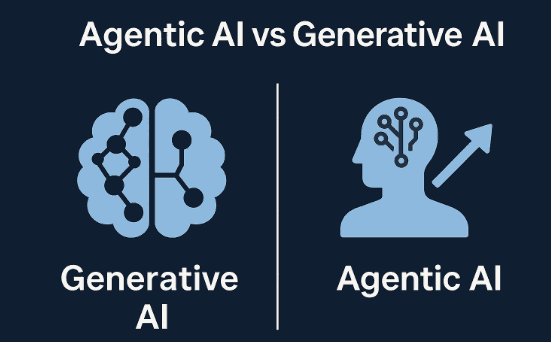
Agentic AI vs Generative AI: Understanding the Shift From Content Creation to Autonomous Action

The AI landscape is undergoing a seismic shift. We’re moving from tools that generate content based on prompts to intelligent systems capable of making decisions, solving problems, and completing tasks independently. This evolution marks the rise of agentic AI, a class of AI models designed not only to respond but also to act.Agentic AI focuses on autonomous decision-making and goal achievement, introducing memory, planning, autonomy, and reasoning into the mix. In contrast, generative AI specializes in content creation, producing text, images, or code when prompted. This blog explores the distinct features and applications of agentic AI and generative AI, emphasizing their unique objectives and capabilities. We will also discuss various use cases for both types of AI, illustrating their relevance and potential impact across different industries.Introduction to Artificial IntelligenceArtificial intelligence (AI) refers to developing computer systems that can perform tasks typically requiring human intelligence, such as learning, problem-solving, and decision-making. AI systems encompass a range of technologies, including traditional AI, machine learning, and deep learning. In recent years, two notable types of AI have emerged: Generative AI and Agentic AI.Unlike Generative AI, which focuses on content creation, Agentic AI operates with minimal human intervention, enabling AI agents to make decisions and act autonomously. This shift from reactive to proactive AI systems marks a significant evolution in artificial intelligence.What is Generative AI? Capabilities and LimitationsBased on training data, Generative AI uses models that can create original content, including text, images, audio, and even entire codebases. These artificial intelligence systems focus on developing new content like text, photos, and music. They work by identifying patterns in data and producing coherent outputs that resemble human work. While revolutionary in their own right, they are inherently reactive; they need user input for every step.Key Capabilities of Generative AI:Generative AI is reshaping how we approach communication, creativity, and content production. Its ability to analyze, interpret, and generate human-like text has unlocked new industry productivity levels. From marketing to design, these tools are now essential assets in the modern digital workflow.Content Generation at ScaleGenerative AI tools can produce vast amounts of content in a fraction of the time it would take a human. Whether drafting product descriptions, writing marketing copy, creating blog posts, generating design variations, or even video, these tools significantly reduce manual effort and increase efficiency for creative teams. This scalability allows businesses to meet growing content demands without proportionally increasing resources.Language UnderstandingModels like GPT-4 and Claude have been trained on diverse and massive datasets, enabling them to understand language, tone, and context nuances. They can answer questions, rephrase sentences, translate between languages, and even simulate conversation with high coherence and fluidity. Their contextual grasp allows them to adapt responses based on subtle cues, making them reliable for customer-facing and internal communication tasks.Creativity and IdeationGenerative AI is a powerful brainstorming assistant. Writers use it to overcome writer’s block, marketers for campaign ideas, and designers for visual inspiration. While it doesn’t possess true creativity, its ability to remix existing data patterns offers a novel kind of computational creativity. It serves as a collaborative partner, accelerating the ideation phase and helping users explore directions they may not have considered independently.Limitations of Generative AIWhile generative AI has made significant strides in natural language processing and content creation, its limitations become apparent in more dynamic or goal-oriented scenarios. These models are reactive by design, lacking the memory, autonomy, and persistence needed for sustained task execution. Understanding these constraints is essential when deciding where and how to apply generative AI effectively.No Goal PersistenceGenerative models do not pursue objectives beyond the current prompt. They have no intrinsic understanding of “goals” and cannot independently determine what needs to be done next. Unlike agentic AI, generative AI cannot execute tasks autonomously and lacks goal persistence. This makes them poor candidates for multi-step, outcome-driven tasks. In workflows that require continuous progress toward a defined objective, their utility quickly diminishes without manual oversight at every step.Lack of MemoryUnlike tools that artificially extend context, generative AI models don’t retain information between sessions. Even in more prolonged interactions, the lack of persistent memory means they can’t track long-term conversations or evolve based on prior exchanges. This short-term context window makes them ill-suited for applications where continuity or historical knowledge is crucial, such as project management or ongoing support.No AutonomyGenerative AI operates only in response to instructions. It doesn’t initiate actions or perform follow-up steps unless explicitly told to do so. As a result, it behaves more like a tool than a teammate, requiring constant human guidance to be productive. This reactive nature limits its usefulness in environments that demand proactive behavior or independent decision-making.What is Agentic AI? Goals, Memory, and AutonomyAgentic AI represents a leap forward by blending large language models (LLMs) with goal-oriented planning, persistent memory, and execution engines. It focuses on decision-making and automation, distinguishing it from generative AI. Rather than generating outputs on demand, agentic AI systems are designed to take in a high-level objective and work toward achieving it, with or without human intervention.Key Capabilities of Agentic AIAgentic AI systems are comprehensive frameworks that manage and optimize complex business processes. Based on real-time data, these systems can autonomously handle tasks such as reordering supplies and adjusting delivery routes, enhancing efficiency and adaptability across various industries, including logistics and smart home management.Autonomous Task ExecutionAgentic AIs can operate across extended timelines to complete complex workflows in dynamic environments with minimal human input. For example, if assigned the task “create a new feature in a web app,” the agent will autonomously break down the task, write the code, test it, and push it to production. It can manage dependencies and adjust the plan dynamically based on feedback or roadblocks encountered.In enterprise environments, this autonomy enables agentic AI to function like a full-stack contributor, capable of initiating, executing, and closing tasks without micromanagement. It can integrate seamlessly into agile workflows, handle ticket-based task assignments, and coordinate with CI/CD systems to ensure smooth deployment cycles with minimal oversight.Memory and Context PersistenceUnlike traditional generative models, agentic systems incorporate short-term and long-term memory layers. This enables them to track progress, revisit prior decisions, learn from past mistakes, and resume incomplete tasks. They behave more like digital employees than AI chatbots.This persistence allows them to maintain continuity over weeks or even months, referencing project history and decisions to make more informed choices. For instance, if a project requirement changes, the AI can revisit prior communications and update work accordingly, reducing knowledge loss and minimizing redundant human handovers.Tool Use and API IntegrationAgentic AI can interact with APIs, databases, SaaS tools, code repositories, and browsers. This allows it to move beyond mere suggestions and perform tasks like updating spreadsheets, querying databases, or deploying cloud infrastructure. It’s not just talking about work—it’s doing the work.Because of this integration capability, agentic AI can orchestrate complete digital workflows, such as generating a report, pulling live data from analytics dashboards, formatting the output, and emailing it to stakeholders. It is a glue layer across fragmented systems, creating end-to-end automation that aligns with operational objectives.Self-Correction and AdaptationThese systems are designed to monitor their behavior and outcomes. They can revise their approach and retry if an error occurs, say, a failed deployment or an inaccurate report. This feedback loop makes them more robust and reliable in real-world, multi-step processes.Over time, this adaptive capability enables the AI to improve accuracy and efficiency. It can develop preferences for optimal paths, detect recurring failure patterns, and implement corrective strategies proactively, similar to how experienced professionals learn from repeated exposure to a task.Role of AI AgentsAI agents are the cornerstone of Agentic AI systems, enabling these systems to operate independently and perform complex tasks. These agents are programmed to handle specific functions such as data analysis, decision-making, and problem-solving. They interact with their environment, gather data, and adapt to changing situations, making them ideal for tasks that require real-time data analysis and decision-making.By integrating AI agents into various business processes, such as customer service, supply chain management, and software development, organizations can automate complex workflows and significantly improve efficiency.How Agentic AI WorksAgentic AI combines machine learning, natural language processing, and large language models to enable AI agents to understand and respond to complex scenarios. These systems operate independently, using existing data to make decisions and take actions with minimal human oversight. Through reinforcement learning, AI agents learn from trial and error, adapting to new situations and improving performance.This capability allows Agentic AI to handle complex scenarios, such as analyzing market data, executing trades, and providing personalized and responsive customer experiences while operating autonomously.Key Differences in Architecture and IntentHere’s a deeper dive into the underlying distinctions between generative and agentic AI:The fundamental difference in intent lies in the purpose of use: generative AI enhances human creativity and communication, while agentic AI is built to replace or augment actual human effort in executing complex workflows. This is where AI innovation comes into play, showcasing its transformative potential across various sectors such as financial services, robotics, urban planning, and human resources.Agentic AI can enhance efficiency, streamline processes, and support decision-making, ultimately revolutionizing traditional practices and paving the way for the next wave of AI advancements.Advantages of Agentic AIAgentic AI offers numerous advantages, including automating complex workflows, improving efficiency, and enhancing decision-making. These systems can operate independently, making them ideal for tasks that require minimal human intervention, such as data analysis and processing. Additionally, Agentic AI can provide personalized and responsive customer experiences, making it an attractive solution for businesses looking to improve customer service.Agentic AI systems can significantly benefit organizations across various industries by streamlining software development, reducing costs, and boosting productivity.Disadvantages of Agentic AIDespite its many advantages, Agentic AI also presents some challenges. One primary concern is the potential for these systems to make decisions that may not align with human values or ethics. Collecting the extensive training data required for Agentic AI can be time-consuming and expensive. Moreover, these systems can be vulnerable to bias and errors, significantly affecting real-world applications. Agentic AI raises concerns about job displacement and underscores the need for ongoing evaluation and monitoring to ensure these systems operate as intended.Real-World Use Cases: ChatGPT vs AutoGPT or DevinChatGPT (Generative AI)Use Case: Generative AI is ideal for content creation, casual Q&A, coding assistance, summarizing documents, brainstorming, and automating responses to customer service inquiries. It can efficiently manage various customer inquiries, such as order status, refunds, and shipping questions. These tools also help teams brainstorm ideas, providing creative suggestions or outlining plans. In customer service scenarios, generative AI can automate responses to frequently asked questions, efficiently managing queries about order status, shipping details, refunds, and other routine issues.How It Works: The AI operates based on user prompts. When a user enters a request or question, the model responds using patterns and information it has been trained on. It draws from a large dataset to generate responses that mimic human-like understanding, even though it doesn’t truly “know” or “understand” in a human sense. The system doesn’t access real-time data or perform tasks in the background—it simply generates text that aligns with the input given.Limitations: Despite its capabilities, generative AI has significant limitations. It does not retain memory between sessions, so context or conversation history is lost once the interaction ends. The model also lacks goal-tracking or the ability to execute tasks—it cannot take initiative or perform real-world actions. To achieve a desired result, users must guide the AI through each process step, making it a tool that relies heavily on clear, continuous input.AutoGPT, Devin, and Other Agentic SystemsAutoGPT: An open-source prototype that wraps GPT with an autonomous framework. It can take a goal like “build a market analysis report” and autonomously plan steps, search the web, compile findings, and write the report—all without further input.Devin by Cognition: Positioned as the world’s first AI software engineer, Devin can manage entire engineering tasks. Positioned as the world’s first AI software engineer, Devin can manage entire engineering tasks. It can plan features, write code, test functionality, and even deploy software without human intervention. Devin is built to operate autonomously and represents a significant leap forward in applying AI to real-world software development workflows. It can:Scope out a software request,Write and test code end-to-end,Push changes to a GitHub repository,Read documentation,Fix errors without external instruction. Devin exemplifies an AI agent, a specific autonomous component performing tasks within the broader agentic AI framework.These tools go beyond suggestions. They act as autonomous executors, able to reason through unexpected situations and course-correct as needed.Integrating agentic AI in various industries, such as healthcare, has shown significant benefits. For instance, Propeller Health uses agentic AI in innovative inhaler technology to collect real-time patient data, enhancing communication between patients and healthcare providers. This integration extends to other sectors, optimizing processes and improving outcomes.Future Implications: From Co-Pilot to Auto-PilotAs generative AI matures into agentic AI, we’ll see its influence in every industry that relies on human decision-making and repetitive workflows. The shift will fundamentally alter how we view human-computer collaboration.1. Software Development:Developers will transition from writing individual functions with AI assistance to delegating entire stories or features to agentic AIs. These systems can write, refactor, and deploy code in an integrated pipeline, freeing engineers to focus on architecture, security, and innovation.2. Business Operations:From automating expense reports and compliance checks to managing CRM updates and drafting executive summaries, agentic AIs will handle tasks that previously required dedicated teams. By integrating AI tools with existing enterprise systems, businesses can enhance data accessibility and break down data silos. This connection empowers agentic AI to optimize workflows across different organizational functions, dramatically streamlining operations and reducing manual workload.3. Customer Support:While generative chatbots handle simple queries, autonomous agents will resolve tickets end-to-end. These advanced AI systems utilize machine learning to create adaptable solutions capable of independent decision-making. They’ll analyze the issue, retrieve customer data, execute actions (like issuing refunds or escalating complex cases), and provide follow-up communication—all autonomously. Autonomous agents enhance customer service by accurately interpreting and responding to customer needs without human intervention.4. Research and Decision-Making:Instead of pulling in raw data or charts, agentic AIs will handle end-to-end competitive analysis, risk assessments, and investment simulations. They’ll analyze data to evaluate options, propose recommendations, and justify decisions with evidence—all without requiring a human analyst at every step. By analyzing data, agentic AI can enhance decision-making and provide evidence-based recommendations, improving efficiency in applications like supply chain management.5. Personal Productivity:Imagine a digital assistant that manages your calendar, responds to emails, plans travel, prioritizes tasks, and flags essential conversations. Agentic AI will empower users to offload the cognitive load of daily coordination, freeing up bandwidth for more meaningful work.Conclusion: The New Era of Agentic IntelligenceThe move from generative AI to agentic AI marks the beginning of a profound shift in technology and how we define intelligence, autonomy, and collaboration. Generative models revolutionized creativity, but agentic systems are set to revolutionize execution. These systems won’t just help us write reports or code—they’ll deliver the outcomes themselves and act independently to complete complex tasks. As we move toward this new era, organizations and individuals alike must prepare for a world that is artificial intelligence focused, specifically agentic AI, which is both an assistant and an autonomous contributor, implementing agentic AI solutions focused to tackle complex challenges that once required significant human oversight.We are witnessing a paradigm shift in digital transformation, where capabilities like natural language understanding, complex reasoning, and data synthesis are becoming foundational. By combining these with robotic process automation, AI systems can now process data, including real-world data, with greater accuracy and intent. This convergence empowers organizations to solve complex problems more efficiently and intelligently than ever.

Aziro Marketing

blogImage

AI the Agile Way

Most of the future facing large companies are aligning themselves as AI companies. This is like a natural progression from apps to chatbots and Big Data to Machine Learning. 62% of organizations will be using Artificial Intelligence (AI) Technologies by 2018, says a recent survey done by narrative science. This is also the reason why we see so many companies feel a pressing need to invest in AI. With passing time, the competition space is heating up and there is a steep task of fully understanding what to achieve using AI. Coupled with this comes the biggest challenge how to achieve it via the traditional engineering delivery teams. This is where partnerships play a vital role. Pivot on Idea Idea should be the pivot not AI. AI is only a great enhancer; it can create a self learning system, reduce human curation cost, or build a human like natural language interface. End product idea should be thought of first; as in is there a market and need for the end product?. AI should not be considered as the selling point. This can even start with a non- AI product to test if there is market fitment for the end product. Begin Small Fast iterations and Lean Startup principles of beginning with an MVP still hold good. Start with leveraging some tested and already validated techniques that can help increase the performance. Few of the validated techniques include reduced human efforts, improved user experience by replacing human intervention with machine driven intelligence, better recommendations etc. to list a few. From this small beginning you can showcase the value that can be added while getting the AI infra tested and proven. Research and Develop in Sprints Cycles Iteration and collaboration between research and engineering holds the key. Both sides should work in similar sprint cycles. This will allow both the teams to understand how the overall work is progressing. The input from engineering, that is the issues and changes are very valuable for the direction of research and vice-versa. Research takes time, having sprint cycle check helps to keep things in control. Ideas can be discussed and demoed; this helps in complete progression.

Aziro Marketing

blogImage

Applied AI

Digital data around us is growing exponentially, this has powered the phenomenon of Artificial Intelligence. This phenomenon will augment human capabilities making us more productive, and positively impact our lives. The AI Ecosystem A Smart device and all its underlying components, be it the software or the hardware, need multiple specialized players to come together, contribute, and build it. The AI world is similar, which has varied dimensions of human like intelligence such as social, creative, emotional and judgmental intelligence embedded within it. At Aziro (formerly MSys Technologies), our applied AI approach brings all these dimensions closer and knit them logically together to define cognitive intelligence. We believe we are part of this ecosystem of AI solutions where we augment our partners by bringing these dimensions of human like intelligence; collaborating using system of intelligence. Applied Artificial Intelligence Machines will exhibit intelligence by perceiving and behaving in the human way. They will also provide scale, iterative learning, ingestion of information from vast, varied and variable data troves. The opportunity is to introduce humanized AI that can simplify business processes, complement human resources and supplement decision making with all possibilities of insights from information. We thus benefit from endless possibilities of building systems that are able to think, act, learn, and perform from every possible interaction. Identifying Opportunities Opportunities are endless in AI; this makes decision making a tough job. A well thought mechanism coupled with some well thought gears are important to derive a right action list. We believe in looking through:- Value :- The trending individual technologies that support AI like IBM Watson or Amazon AI or Microsoft Cognitive or Google Deep mind’s Alpha Go made great headlines. Can those be applied to your business to serve a broader goal that matches with your company strategy, driving profits? Business should always ask:- How can AI improve product outcomes? Can service quality be made better with AI? Whether AI can help create new user experience and improve the existing setup, Can AI bring down cost and uncertainty for critical projects? Will it be possible to Apply, Scale, Preserve and Enhance human learning and experiences with AI? Applying Applied AI Taking AI out of research laboratory and making it part of daily use is all about applying AI. Think big, start small and use agile. Experience the example below:- Rule based Digital Assistant You have 2 meetings tomorrow 9:00 – 11:00 16:00 – 17:00 Digital Assistant – Powered by AI Today is Thursday, You have a travel planned tonight to New York. You are low on your BP medicines, I have placed an order which will be made available to you at your hotel in NY. Tomorrow your first client meeting is at 9:00 am but your report is not ready yet as inputs are awaited from research team; I have already sent them a reminder. Your next client meeting is at 16:00 hrs. Do you want me to research and prepare on the latest findings in cancer medication before you meet your client? This example helps us to look at AI as a companion rather than a competitor. It will enrich families and businesses by simplifying how human and machines work with each other, collaborating among themselves. We strongly believe applied AI will enhance, evolve its own components and devices to work in harmony. This will create a real-world impact at enormous scale.

Aziro Marketing

blogImage

Artificial Intelligence Taking over Wall Street trading

One of the biggest reason trading decisions are affected is because of human emotions. Machines and algorithms can make complicated decisions and execute trades at a rate which no human can match and is not influenced by emotions. The parameters these algorithms take into consideration are price variations, macroeconomic data volume changes similar to accounting information of different corporate companies and news articles from various times topredict the nature of a particular stock.Stock prediction can be done using the company's historical data. This historical data can be used to perform either Linear regression or Support Vector Regression depending on the complexity of the system, to discover trends in the stock market. The algorithm can access various real time news papers and journals to retrieve the latest news and information regarding a specific company. This data is then processed and analysed along with the historical data and data derived from the quarterly results and press releases of that company. This helps in predicting a stock price of a specific company.If we need to analyze the whole market, consisting of more than 6000 companies listed in the New York Stock Exchange, we can do that too in the similar manner by navigating through the regulatory filings, social media posts, real time news feed and other finance related metrics also involving elements such as correlations and valuations in order to predict investments which are considered undervalued.AI is already in use by institutional traders and are incorporated in tools used for stock trading. Some of which are completely automated and are used by Hedge Funds. Most of these systems can detect minute changes caused by a number of factors and historical data. As a result thousands of trades are performed on single day.An interesting example:It was noticed that, everytime Anne Hathaway was mentioned in the news, the share price of Berkshire Hathaway increased. This was probably because, there was some algorithm from a trading firm running automatic trades whenever it came across “Hathaway” in the news.This particular example is a false positive and the fact that this system can run automatic trades based on real time news feed is pretty interesting. This technique requires data ingestion, sentiment analysis and entity detection.If the system or algorithm can detect and react to positive news feed faster than anybody else in the market, then one can make the profit that is the leap(or decrease) in price.Citation: http://www.eurekahedge.com/Research/News/1614/Artificial-Intelligence- AI-Hedge-Fund-Index- Strategy-Profile

Aziro Marketing

blogImage

Machine Learning Predictive Analytics: A Comprehensive Guide

I. Introduction In today’s data-driven world, businesses are constantly bombarded with information. But what if you could harness that data to not just understand the past, but also predict the future? This is the power of machine learning (ML) combined with predictive analytics. Machine learning (ML) is a subset of artificial intelligence that enables systems to learn from data and improve their performance over time without being explicitly programmed. Core concepts in ML include algorithms, which are the set of rules that guide data processing and learning; training data, which is the historical data used to teach the model; and predictions, which are the outcomes the model generates based on new input data. The three pillars of data analytics are crucial here: the needs of the entity using the model, the data and technology for analysis, and the resulting actions and insights. Predictive analytics involves using statistical techniques and algorithms to analyze historical data and make predictions about future events. It uses statistics and modeling techniques to forecast future outcomes, and machine learning aims to make predictions for future outcomes based on developed models. It plays a crucial role in business decision-making by providing insights that help organizations anticipate trends, understand customer behavior, and optimize operations. The synergy between machine learning and predictive analytics lies in their complementary strengths. ML algorithms enhance predictive analytics by improving the accuracy and reliability of predictions through continuous learning and adaptation. This integration allows businesses to leverage vast amounts of data to make more informed, data-driven decisions, ultimately leading to better outcomes and a competitive edge in the market. II. Demystifying Machine Learning Machine learning (ML) covers a broad spectrum of algorithms, each designed to tackle different types of problems. However, for the realm of predictive analytics, one of the most effective and commonly used approaches is supervised learning. Understanding Supervised Learning Supervised learning operates similarly to a student learning under the guidance of a teacher. In this context, the “teacher” is the training data, which consists of labeled examples. These examples contain both the input (features) and the desired output (target variable). For instance, if we want to predict customer churn (cancellations), the features might include a customer’s purchase history, demographics, and engagement metrics, while the target variable would be whether the customer churned or not (yes/no). The Supervised Learning Process Data Collection: The first step involves gathering a comprehensive dataset relevant to the problem at hand. For a churn prediction model, this might include collecting data on customer transactions, interactions, and other relevant metrics. Data Preparation: Once the data is collected, it needs to be cleaned and preprocessed. This includes handling missing values, normalizing features, and converting categorical variables into numerical formats if necessary. Data preparation is crucial as the quality of data directly impacts the model’s performance. Model Selection: Choosing the right algorithm is critical. For predictive analytics, common algorithms include linear regression for continuous outputs and logistic regression for binary classification tasks. Predictive analytics techniques such as regression, classification, clustering, and time series models are used to determine the likelihood of future outcomes and identify patterns in data. The choice depends on the nature of the problem and the type of data. Training: The prepared data is then used to train the model. This involves feeding the labeled examples into the algorithm, which learns the relationship between the input features and the target variable. For instance, in churn prediction, the model learns how features like customer purchase history and demographics correlate with the likelihood of churn. Evaluation: To ensure the model generalizes well to new, unseen data, it’s essential to evaluate its performance using a separate validation set. Metrics like accuracy, precision, recall, and F1-score help in assessing how well the model performs. Prediction: Once trained and evaluated, the model is ready to make predictions on new data. It can now predict whether a new customer will churn based on their current features, allowing businesses to take proactive measures. Example of Supervised Learning in Action Consider a telecommunications company aiming to predict customer churn. The training data might include features such as: Customer Tenure: The duration the customer has been with the company. Monthly Charges: The amount billed to the customer each month. Contract Type: Whether the customer is on a month-to-month, one-year, or two-year contract. Support Calls: The number of times the customer has contacted customer support. The target variable would be whether the customer has churned (1 for churned, 0 for not churned). By analyzing this labeled data, the supervised learning model can learn patterns and relationships that indicate a higher likelihood of churn. For example, it might learn that customers with shorter tenures and higher monthly charges are more likely to churn. Once the model is trained, it can predict churn for new customers based on their current data. This allows the telecommunications company to identify at-risk customers and implement retention strategies to reduce churn. Benefits of Supervised Learning for Predictive Analytics Accuracy: Supervised learning models can achieve high accuracy by learning directly from labeled data. Interpretability: Certain supervised learning models, such as decision trees, provide clear insights into how decisions are made, which is valuable for business stakeholders. Efficiency: Once trained, these models can process large volumes of data quickly, making real-time predictions feasible. Supervised learning plays a pivotal role in predictive analytics, enabling businesses to make data-driven decisions. By understanding the relationships between features and target variables, companies can forecast future trends, identify risks, and seize opportunities. Through effective data collection, preparation, model selection, training, and evaluation, businesses can harness the power of supervised learning to drive informed decision-making and strategic planning. Types of ML Models Machine learning (ML) models can be broadly categorized into three types: supervised learning, unsupervised learning, and reinforcement learning. Reinforcement Learning Reinforcement learning involves training an agent to make a sequence of decisions by rewarding desired behaviors and punishing undesired ones. The agent learns to achieve a goal by interacting with its environment, continuously improving its strategy based on feedback from its actions. Key Concepts Agent: The learner or decision-maker. Environment: The external system the agent interacts with. Actions: The set of all possible moves the agent can make. Rewards: Feedback from the environment to evaluate the actions. Examples Gaming: Teaching AI to play games like chess or Go. Robotics: Training robots to perform tasks, such as navigating a room or assembling products. Use Cases Dynamic Decision-Making: Adaptive systems in financial trading. Automated Systems: Self-driving cars learning to navigate safely. Supervised Learning Supervised learning involves using labeled data to train models to make predictions or classifications. Supervised machine learning models are trained with labeled data sets, allowing the models to learn and grow more accurate over time. The model learns a mapping from input features to the desired output by identifying patterns in the labeled data. This type of ML is particularly effective for predictive analytics, as it can forecast future trends based on historical data. Examples Regression: Predicts continuous values (e.g., predicting house prices based on size and location). Classification: Categorizes data into predefined classes (e.g., spam detection in emails, disease diagnosis). Use Cases Predictive Analytics: Forecasting sales, demand, or trends. Customer Segmentation: Identifying distinct customer groups for targeted marketing. Unsupervised Learning Unsupervised learning models work with unlabeled data, aiming to uncover hidden patterns or intrinsic structures within the data. These models are essential for exploratory data analysis, where the goal is to understand the data’s underlying structure without predefined labels. Unsupervised machine learning algorithms identify commonalities in data, react based on the presence or absence of commonalities, and apply techniques such as clustering and data compression. Examples Clustering: Groups similar data points together (e.g., customer segmentation without predefined classes). Dimensionality Reduction: Reduces the number of variables under consideration (e.g., Principal Component Analysis, which simplifies data visualization and accelerates training processes). Use Cases Market Basket Analysis: Discovering associations between products in retail. Anomaly Detection: Identifying outliers in data, such as fraud detection in finance. The ML Training Process The machine learning training process typically involves several key steps: Data Preparation Collecting, cleaning, and transforming raw data into a suitable format for training. This step includes handling missing values, normalizing data, and splitting it into training and testing sets. Model Selection Choosing the appropriate algorithm that fits the problem at hand. Factors influencing this choice include the nature of the data, the type of problem (classification, regression, etc.), and the specific business goals. Training Feeding the training data into the selected model so that it can learn the underlying patterns. This phase involves tuning hyperparameters and optimizing the model to improve performance. Evaluation Assessing the model’s performance using the test data. Metrics such as accuracy, precision, recall, and F1-score help determine how well the model generalizes to new, unseen data. Common Challenges in ML Projects Despite its potential, machine learning projects often face several challenges: Data Quality Importance: The effectiveness of ML models is highly dependent on the quality of the data. Poor data quality can significantly hinder model performance. Challenges Missing Values: Gaps in the dataset can lead to incomplete analysis and inaccurate predictions. Noise: Random errors or fluctuations in the data can distort the model’s learning process. Inconsistencies: Variations in data formats, units, or measurement standards can create confusion and inaccuracies. Solutions Data Cleaning: Identify and rectify errors, fill in missing values, and standardize data formats. Data Augmentation: Enhance the dataset by adding synthetic data generated from the existing data, especially for training purposes. Bias Importance: Bias in the data can lead to unfair or inaccurate predictions, affecting the reliability of the model. Challenges Sampling Bias: When the training data does not represent the overall population, leading to skewed predictions. Prejudicial Bias: Historical biases present in the data that propagate through the model’s predictions. Biases in machine learning systems trained on specific data, including language models and human-made data, pose ethical questions and challenges, especially in fields like health care and predictive policing. Solutions Diverse Data Collection: Ensure the training data is representative of the broader population. Bias Detection and Mitigation: Implement techniques to identify and correct biases during the model training process. Interpretability Importance: Complex ML models, especially deep learning networks, often act as black boxes, making it difficult to understand how they arrive at specific predictions. This lack of transparency can undermine trust and hinder the model’s adoption, particularly in critical applications like healthcare and finance. Challenges Opaque Decision-Making: Difficulty in tracing how inputs are transformed into outputs. Trust and Accountability: Stakeholders need to trust the model’s decisions, which requires understanding its reasoning. Solutions Explainable AI (XAI): Use methods and tools that make ML models more interpretable and transparent. Model Simplification: Opt for simpler models that offer better interpretability when possible, without sacrificing performance. By understanding these common challenges in machine learning projects—data quality, bias, and interpretability—businesses can better navigate the complexities of ML and leverage its full potential for predictive analytics. Addressing these challenges is crucial for building reliable, fair, and trustworthy models that can drive informed decision-making across various industries. III. Powering Predictions: Core Techniques in Predictive Analytics Supervised learning forms the backbone of many powerful techniques used in predictive analytics. Here, we’ll explore some popular options to equip you for various prediction tasks: 1. Linear Regression: Linear regression is a fundamental technique in predictive analytics, and understanding its core concept empowers you to tackle a wide range of prediction tasks. Here’s a breakdown of what it does and how it’s used: The Core Idea Linear regression helps you establish a mathematical relationship between your sales figures (the dependent variable) and factors that might influence them (independent variables). These independent variables could be things like weather conditions, upcoming holidays, or even historical sales data from previous years. The Math Behind the Magic While the underlying math might seem complex, the basic idea is to create a linear equation that minimizes the difference between the actual values of the dependent variable and the values predicted by the equation based on the independent variables. Think of it like drawing a straight line on a graph that best approximates the scattered points representing your data. Making Predictions Once the linear regression model is “trained” on your data (meaning it has identified the best-fitting line), you can use it to predict the dependent variable for new, unseen data points. For example, if you have data on new houses with specific features (square footage, bedrooms, location), you can feed this data into the trained model, and it will predict the corresponding house price based on the learned relationship. Applications Across Industries The beauty of linear regression lies in its versatility. Here are some real-world examples of its applications: Finance: Predicting stock prices based on historical data points like past performance, company earnings, and market trends. Real Estate: Estimating the value of a property based on factors like location, size, and features like number of bedrooms and bathrooms. Economics: Forecasting market trends for various sectors by analyzing economic indicators like inflation rates, consumer spending, and unemployment figures. Sales Forecasting: Predicting future sales figures for a product based on historical sales data, marketing campaigns, and economic factors. Beyond the Basics It’s important to note that linear regression is most effective when the relationship between variables is indeed linear. For more complex relationships, other machine learning models might be better suited. However, linear regression remains a valuable tool due to its simplicity, interpretability, and its effectiveness in a wide range of prediction tasks. 2. Classification Algorithms These algorithms excel at predicting categorical outcomes (yes/no, classify data points into predefined groups). Here are some common examples: Decision Trees Decision trees are a popular machine learning model that function like a flowchart. They ask a series of questions about the data to arrive at a classification or decision. Their intuitive structure makes them easy to interpret and visualize, which is ideal for understanding the reasoning behind predictions. How Decision Trees Work Root Node: The top node represents the entire dataset, and the initial question is asked here. Internal Nodes: Each internal node represents a question or decision rule based on one of the input features. Depending on the answer, the data is split and sent down different branches. Leaf Nodes: These are the terminal nodes that provide the final classification or decision. Each leaf node corresponds to a predicted class or outcome. Advantages of Decision Trees Interpretability: They are easy to understand and interpret. Each decision path can be followed to understand how a particular prediction was made. Visualization: Decision trees can be visualized, which helps in explaining the model to non-technical stakeholders. No Need for Data Scaling: They do not require normalization or scaling of data. Applications of Decision Trees Customer Churn Prediction: Decision trees can predict whether a customer will cancel a subscription based on various features like usage patterns, customer service interactions, and contract details. Loan Approval Decisions: They can classify loan applicants as low or high risk by evaluating factors such as credit score, income, and employment history. Example: Consider a bank that wants to automate its loan approval process. The decision tree model can be trained on historical data with features like: Credit Score: Numerical value indicating the applicant’s creditworthiness. Income: The applicant’s annual income. Employment History: Duration and stability of employment. The decision tree might ask: “Is the credit score above 700?” If yes, the applicant might be classified as low risk. “Is the income above $50,000?” If yes, the risk might be further assessed. “Is the employment history stable for more than 2 years?” If yes, the applicant could be deemed eligible for the loan. Random Forests Random forests are an advanced ensemble learning technique that combines the power of multiple decision trees to create a “forest” of models. This approach results in more robust and accurate predictions compared to single decision trees. How Random Forests Work Creating Multiple Trees: The algorithm generates numerous decision trees using random subsets of the training data and features. Aggregating Predictions: Each tree in the forest makes a prediction, and the final output is determined by averaging the predictions (for regression tasks) or taking a majority vote (for classification tasks). Advantages of Random Forests Reduced Overfitting: By averaging multiple trees, random forests are less likely to overfit the training data, which improves generalization to new data. Increased Accuracy: The ensemble approach typically offers better accuracy than individual decision trees. Feature Importance: Random forests can measure the importance of each feature in making predictions, providing insights into the data. Applications of Random Forests Fraud Detection: By analyzing transaction patterns, random forests can identify potentially fraudulent activities with high accuracy. Spam Filtering: They can classify emails as spam or not spam by evaluating multiple features such as email content, sender information, and user behavior. Example: Consider a telecom company aiming to predict customer churn. Random forests can analyze various customer attributes and behaviors, such as: Usage Patterns: Call duration, data usage, and service usage frequency. Customer Demographics: Age, location, and occupation. Service Interactions: Customer service calls, complaints, and satisfaction scores. The random forest model will: Train on Historical Data: Use past customer data to build multiple decision trees. Make Predictions: Combine the predictions of all trees to classify whether a customer is likely to churn. Support Vector Machines (SVMs) and Neural Networks Support Vector Machines (SVMs) are powerful supervised learning models used for classification and regression tasks. They excel at handling high-dimensional data and complex classification problems. How SVMs Work Hyperplane Creation: SVMs create a hyperplane that best separates different categories in the data. The goal is to maximize the margin between the closest data points of different classes, known as support vectors. Kernel Trick: SVMs can transform data into higher dimensions using kernel functions, enabling them to handle non-linear classifications effectively. Advantages of SVMs High Dimensionality: SVMs perform well with high-dimensional data and are effective in spaces where the number of dimensions exceeds the number of samples. Robustness: They are robust to overfitting, especially in high-dimensional space. Applications of SVMs Image Recognition: SVMs are widely used for identifying objects in images by classifying pixel patterns. Sentiment Analysis: They classify text as positive, negative, or neutral based on word frequency, context, and metadata. Example: Consider an email service provider aiming to filter spam. SVMs can classify emails based on features such as: Word Frequency: The occurrence of certain words or phrases commonly found in spam emails. Email Metadata: Sender information, subject line, and other metadata. The SVM model will: Train on Labeled Data: Use a dataset of labeled emails (spam or not spam) to find the optimal hyperplane that separates the two categories. Classify New Emails: Apply the trained model to new emails to determine whether they are spam or not based on the learned patterns. Beyond Classification and Regression Predictive analytics also includes other valuable techniques: Time series forecasting Analyzes data points collected over time (daily sales figures, website traffic) to predict future trends and patterns. Predictive modeling is a statistical technique used in predictive analysis, along with decision trees, regressions, and neural networks. Crucial for inventory management, demand forecasting, and resource allocation. Example: Forecasting sales for the next quarter based on past sales data. Anomaly detection Identifies unusual patterns in data that deviate from the norm. This can be useful for fraud detection in financial transactions or detecting equipment failures in manufacturing. Predictive analytics models can be grouped into four types, depending on the organization’s objective. Example: Detecting fraudulent transactions by identifying unusual spending patterns. By understanding these core techniques, you can unlock the potential of predictive analytics to make informed predictions and gain a competitive edge in your industry. IV. Unveiling the Benefits: How Businesses Leverage Predictive Analytics Predictive analytics empowers businesses across various industries to make data-driven decisions and improve operations. Let’s delve into some real-world examples showcasing its transformative impact: Retail: Predicting Customer Demand and Optimizing Inventory Management Using Historical Data Retailers use predictive analytics to forecast customer demand, ensuring that they have the right products in stock at the right time. By analyzing historical sales data, seasonal trends, and customer preferences, they can optimize inventory levels, reduce stockouts, and minimize excess inventory. Example: A fashion retailer uses predictive analytics to anticipate demand for different clothing items each season, allowing them to adjust orders and stock levels accordingly. Finance: Detecting Fraudulent Transactions and Assessing Creditworthiness Financial institutions leverage predictive analytics to enhance security and assess risk. Predictive analytics determines the likelihood of future outcomes using techniques like data mining, statistics, data modeling, artificial intelligence, and machine learning. By analyzing transaction patterns, predictive models can identify unusual activities that may indicate fraud. Additionally, predictive analytics helps in evaluating creditworthiness by assessing an individual’s likelihood of default based on their financial history and behavior. Example: A bank uses predictive analytics to detect potential credit card fraud by identifying transactions that deviate from a customer’s typical spending patterns. Manufacturing: Predictive Maintenance for Equipment and Optimizing Production Processes In manufacturing, predictive analytics is used for predictive maintenance, which involves forecasting when equipment is likely to fail. Statistical models are used in predictive maintenance to forecast equipment failures and optimize production processes by identifying inefficiencies. This allows for proactive maintenance, reducing downtime and extending the lifespan of machinery. Additionally, predictive models can optimize production processes by identifying inefficiencies and recommending improvements. Example: An automotive manufacturer uses sensors and predictive analytics to monitor the condition of production equipment, scheduling maintenance before breakdowns occur. Marketing: Personalizing Customer Experiences and Targeted Advertising Marketing teams use predictive analytics to personalize customer experiences and create targeted advertising campaigns. By analyzing customer data, including purchase history and online behavior, predictive models can identify customer segments and predict future behaviors, enabling more effective and personalized marketing strategies. Predictive analysis helps in understanding customer behavior, targeting marketing campaigns, and identifying possible future occurrences by analyzing the past. Example: An e-commerce company uses predictive analytics to recommend products to customers based on their browsing and purchase history, increasing sales and customer satisfaction. These are just a few examples of how businesses across industries are harnessing the power of predictive analytics to gain a competitive edge. As machine learning and data science continue to evolve, the possibilities for leveraging predictive analytics will only become more extensive, shaping the future of business decision-making. V. Building a Predictive Analytics Project: A Step-by-Step Guide to Predictive Modeling So, are you excited to harness the power of predictive analytics for your business? Here is a step-by-step approach to building your own predictive analytics project. Follow these stages, and you’ll be well on your way to harnessing the power of data to shape the future of your business: Identify Your Business Challenge: Every successful prediction starts with a specific question. What burning issue are you trying to solve? Are you struggling with high customer churn and need to identify at-risk customers for targeted retention campaigns? Perhaps inaccurate sales forecasts are leading to inventory issues. Clearly define the problem you want your predictive analytics project to address. This targeted approach ensures your project delivers impactful results that directly address a pain point in your business. Gather and Prepare Your Data: Imagine building a house – you need quality materials for a sturdy structure. Similarly, high-quality data is the foundation of your predictive model. Gather relevant data from various sources like sales records, customer profiles, or website traffic. Remember, the quality of your data is crucial. Clean and organize it to ensure its accuracy and completeness for optimal analysis. Choose the Right Tool for the Job: The world of machine learning models offers a variety of options, each with its strengths. There’s no one-size-fits-all solution. Once you understand your problem and the type of data you have, you can select the most appropriate model. Think of it like picking the right tool for a specific task. Linear regression is ideal for predicting numerical values, while decision trees excel at classifying data into categories. Train Your Predictive Model: Now comes the fun part – feeding your data to the model! This “training” phase allows the model to learn from the data and identify patterns and relationships. Imagine showing a student a set of solved math problems – the more they practice, the better they can tackle new problems on their own. The more data your model is trained on, the more accurate its predictions become. Test and Evaluate Your Model: Just like you wouldn’t trust a new car without a test drive, don’t rely on your model blindly. Evaluate its performance on a separate dataset to see how well it predicts unseen situations. This ensures it’s not simply memorizing the training data but can actually generalize and make accurate predictions for real-world scenarios. Remember, building a successful predictive analytics project is a collaborative effort. Don’t hesitate to seek help from data analysts or data scientists if needed. With clear goals, the right data, and a step-by-step approach, you can unlock the power of predictive analytics to gain valuable insights and make smarter decisions for your business. VI. The Future Landscape: Emerging Trends Shaping Predictive Analytics The world of predictive analytics is constantly evolving, with exciting trends shaping its future: Rise of Explainable AI (XAI): Machine learning models can be complex, making it challenging to understand how they arrive at predictions. XAI aims to address this by making the decision-making process of these models more transparent and interpretable. This is crucial for building trust in predictions, especially in high-stakes situations. Imagine a doctor relying on an AI-powered diagnosis tool – XAI would help explain the reasoning behind the prediction, fostering confidence in the decision. Cloud Computing and Big Data: The ever-growing volume of data (big data) can be overwhelming for traditional computing systems. Cloud computing platforms offer a scalable and cost-effective solution for storing, processing, and analyzing this data. This empowers businesses of all sizes to leverage the power of predictive analytics, even if they lack extensive IT infrastructure. Imagine a small retail store – cloud computing allows them to analyze customer data and make data-driven decisions without needing a massive in-house server system. Additionally, neural networks are used in deep learning techniques to analyze complex relationships and handle big data. Ethical Considerations: As AI and predictive analytics become more pervasive, ethical considerations come to the forefront. Bias in training data can lead to biased predictions, potentially leading to discriminatory outcomes. It’s crucial to ensure fairness and transparency in using these tools. For instance, an AI model used for loan approvals should not discriminate against certain demographics based on biased historical data. By staying informed about these emerging trends and approaching AI development with a focus on responsible practices, businesses can harness the immense potential of predictive analytics to make informed decisions, optimize operations, and gain a competitive edge in the ever-changing marketplace. VII. Wrapping Up Throughout this guide, we’ve explored the exciting intersection of machine learning and predictive analytics. We’ve seen how machine learning algorithms can transform raw data into powerful insights, empowering businesses to predict future trends and make data-driven decisions. Here are the key takeaways to remember: Machine learning provides the engine that fuels predictive analytics. These algorithms can learn from vast amounts of data, identifying patterns and relationships that might go unnoticed by traditional methods. Predictive analytics empowers businesses to move beyond simple reactive responses. By anticipating future trends and customer behavior, businesses can proactively optimize their operations, mitigate risks, and seize new opportunities. The power of predictive analytics extends across various industries. From retailers predicting customer demand to manufacturers streamlining production processes, this technology offers a transformative advantage for businesses of all sizes. As we look towards the future, the potential of predictive analytics continues to expand. The rise of Explainable AI (XAI) will build trust and transparency in predictions, while cloud computing and big data solutions will make this technology more accessible than ever before. However, it’s crucial to address ethical considerations and ensure these powerful tools are used responsibly and fairly. The future of business is undoubtedly data-driven, and predictive analytics is poised to be a game-changer. As you embark on your journey with this powerful technology, remember, the future is not set in stone. So, seize the opportunity, leverage the power of predictive analytics, and watch your business thrive in the exciting world of tomorrow.

Aziro Marketing

EXPLORE ALL TAGS
2019 dockercon
Advanced analytics
Agentic AI
agile
AI
AI ML
AIOps
Amazon Aws
Amazon EC2
Analytics
Analytics tools
AndroidThings
Anomaly Detection
Anomaly monitor
Ansible Test Automation
apache
apache8
Apache Spark RDD
app containerization
application containerization
applications
Application Security
application testing
artificial intelligence
asynchronous replication
automate
automation
automation testing
Autonomous Storage
AWS Lambda
Aziro
Aziro Technologies
big data
Big Data Analytics
big data pipeline
Big Data QA
Big Data Tester
Big Data Testing
bitcoin
blockchain
blog
bluetooth
buildroot
business intelligence
busybox
chef
ci/cd
CI/CD security
cloud
Cloud Analytics
cloud computing
Cloud Cost Optimization
cloud devops
Cloud Infrastructure
Cloud Interoperability
Cloud Native Solution
Cloud Security
cloudstack
cloud storage
Cloud Storage Data
Cloud Storage Security
Codeless Automation
Cognitive analytics
Configuration Management
connected homes
container
Containers
container world 2019
container world conference
continuous-delivery
continuous deployment
continuous integration
Coronavirus
Covid-19
cryptocurrency
cyber security
data-analytics
data backup and recovery
datacenter
data protection
data replication
data-security
data-storage
deep learning
demo
Descriptive analytics
Descriptive analytics tools
development
devops
devops agile
devops automation
DEVOPS CERTIFICATION
devops monitoring
DevOps QA
DevOps Security
DevOps testing
DevSecOps
Digital Transformation
disaster recovery
DMA
docker
dockercon
dockercon 2019
dockercon 2019 san francisco
dockercon usa 2019
docker swarm
DRaaS
edge computing
Embedded AI
embedded-systems
end-to-end-test-automation
FaaS
finance
fintech
FIrebase
flash memory
flash memory summit
FMS2017
GDPR faqs
Glass-Box AI
golang
GraphQL
graphql vs rest
gui testing
habitat
hadoop
hardware-providers
healthcare
Heartfullness
High Performance Computing
Holistic Life
HPC
Hybrid-Cloud
hyper-converged
hyper-v
IaaS
IaaS Security
icinga
icinga for monitoring
Image Recognition 2024
infographic
InSpec
internet-of-things
investing
iot
iot application
iot testing
java 8 streams
javascript
jenkins
KubeCon
kubernetes
kubernetesday
kubernetesday bangalore
libstorage
linux
litecoin
log analytics
Log mining
Low-Code
Low-Code No-Code Platforms
Loyalty
machine-learning
Meditation
Microservices
migration
Mindfulness
ML
mobile-application-testing
mobile-automation-testing
monitoring tools
Mutli-Cloud
network
network file storage
new features
NFS
NVMe
NVMEof
NVMes
Online Education
opensource
openstack
opscode-2
OSS
others
Paas
PDLC
Positivty
predictive analytics
Predictive analytics tools
prescriptive analysis
private-cloud
product sustenance
programming language
public cloud
qa
qa automation
quality-assurance
Rapid Application Development
raspberry pi
RDMA
real time analytics
realtime analytics platforms
Real-time data analytics
Recovery
Recovery as a service
recovery as service
rsa
rsa 2019
rsa 2019 san francisco
rsac 2018
rsa conference
rsa conference 2019
rsa usa 2019
SaaS Security
san francisco
SDC India 2019
SDDC
security
Security Monitoring
Selenium Test Automation
selenium testng
serverless
Serverless Computing
Site Reliability Engineering
smart homes
smart mirror
SNIA
snia india 2019
SNIA SDC 2019
SNIA SDC INDIA
SNIA SDC USA
software
software defined storage
software-testing
software testing trends
software testing trends 2019
SRE
STaaS
storage
storage events
storage replication
Storage Trends 2018
storage virtualization
support
Synchronous Replication
technology
tech support
test-automation
Testing
testing automation tools
thought leadership articles
trends
tutorials
ui automation testing
ui testing
ui testing automation
vCenter Operations Manager
vCOPS
virtualization
VMware
vmworld
VMworld 2019
vmworld 2019 san francisco
VMworld 2019 US
vROM
Web Automation Testing
web test automation
WFH

LET'S ENGINEER

Your Next Product Breakthrough

Book a Free 30-minute Meeting with our technology experts.

Aziro has been a true engineering partner in our digital transformation journey. Their AI-native approach and deep technical expertise helped us modernize our infrastructure and accelerate product delivery without compromising quality. The collaboration has been seamless, efficient, and outcome-driven.

Customer Placeholder
CTO

Fortune 500 company