Introduction
Imagine sprinting in a race with no finish line.
You run faster, harder — yet never win.
That’s what chasing features without strategy feels like.
In today’s IT-driven product ecosystem, speed is often mistaken for progress. Teams keep adding integrations, toggles, and design themes — but forget the why.
Strategy is what connects motion to meaning.
The Feature Factory Trap
Many organizations equate productivity with success:
“If we shipped 20 new features this quarter, we must be doing great.”
But the truth?
Features add noise. Strategy creates outcomes.
Real-world Use Cases
- SaaS Overload: A SaaS platform launched 100+ integrations in a year to “expand options.” User adoption fell by 15%.
Why?
They solved fringe problems instead of core pain points. - Dark Mode vs Checkout Fix: An e-commerce team prioritized “dark mode” over fixing checkout errors.
Users quit before they could even enjoy the new theme.
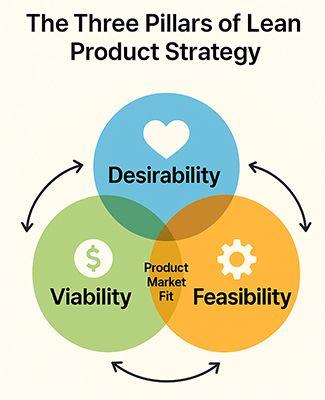
The Three Pillars of Lean Product Strategy
Every strong IT product strategy rests on three timeless lenses:
- Desirability – Do customers truly want it? This ensures you’re solving the right problem, not just building for novelty.
- Viability – Does it make business sense? Every decision should connect back to measurable outcomes or ROI.
- Feasibility – Can we realistically build and scale it? Aligns ambition with technical and operational capacity.
These lenses transform teams from reactive builders to purposeful creators.
Strategy Across the Product Lifecycle
Strategy isn’t a one-time phase — it’s a continuous discipline:
- Concept Acceptance: Validate the problem, not the feature. Use user research, surveys, and mock testing.
- MVP Development: Test assumptions with minimal investment. Dropbox began with a demo video — no code, pure validation.
- Market Testing: Gather real-world feedback, not opinions. Learn fast, adapt faster.
- Prioritized Roadmap: Turn insights into sequenced delivery. Slack deprioritized “offline mode” early on to focus on reliable real-time messaging — a strategic masterstroke.
Strategy in Product Development Execution
Even the most elegant strategy is useless unless it flows into execution.
- Backlog Creation: Translate strategy into prioritized epics aligned with outcomes.
- Development Sprints: Every story must ladder up to business or user value.
- User Acceptance Testing (UAT): Strategy validation in disguise.
-
- UAT Framework:
- Develop Plan
- Identify Real-World Scenarios
- Select Testing Teams
- Test & Document
- Update Code, Re-Test & Sign-Off
- UAT Framework:
-
Release Notes & Documentation: Close the loop. Every change should explain why it exists.
Frameworks That Shape Winning Product Strategy
Having a strategy is good.
Having a repeatable way to build one is better.
- North Star Framework:
Focus around one measurable outcome that reflects customer value.
Example: Spotify’s “Minutes Streamed” metric.
→ Teams using North Star Metrics align 40% faster across functions.
- OKR Framework (Objectives & Key Results):
Connect vision to measurable impact.
Example: Google uses OKRs to ensure every sprint outcome aligns to business growth.
- RICE Prioritization Model:
Formula: (Reach × Impact × Confidence) / Effort.
→ Teams using RICE-style scoring report 32% higher release-to-impact ratios.
- Kano Model:
Classifies features into Basic, Performance, and Delighters.
Helps maintain balance between innovation and necessity.
Case Studies: When Strategy Wins
- FinTech: Stripe
Stripe didn’t compete by adding 200 payment types. Its strategy? A frictionless developer experience.
That clarity turned API usability into a growth engine — powering over 60% of global startups today.
- E-Commerce: Shopify
Shopify avoided feature sprawl by doubling down on enabling entrepreneurs to launch quickly.
- SaaS: Notion
Instead of chasing every enterprise feature, Notion focused on modularity and user empowerment.
Its strategic bet on customization paid off — achieving 4M+ daily active users by 2024.
How AI Is Powering Strategic Product Management
AI is no longer a “nice-to-have” — it’s a strategy multiplier.
- Market Intelligence: Tools like Crayon or SimilarWeb analyze competitors for smarter positioning.
- Customer Insights: NLP models process feedback from reviews, tickets, and NPS responses.
- Prioritization Assistance: Tools like Aha! and ProductBoard use AI to score ideas automatically.
- Predictive Analytics: AI models forecast feature adoption or churn risk.
- UAT Automation: AI-driven test case generation shortens feedback loops.
Why This Matters
“A good strategy doesn’t slow you down — it ensures you’re running in the right direction.”
Great Product Managers don’t ask,
“What can we build next?”
They ask,
“What should we build next — and why now?”
Harvard Business Review notes that companies using strategic prioritization frameworks achieve 33% higher success rates in product launches than those chasing unprioritized features.
Next in the Series
Curious what PMs truly own beyond features?
Stay tuned for Post 3: Product Manager vs Product Owner vs Project Manager
— breaking down real accountability in the product world.
Article written by Deep Verma | Exploring product management beyond the backlog
Follow the series: #BeyondTheBacklog | #AziroOnProducts