Automation has been the engine of IT productivity for years, eliminating repetitive toil and standardizing routine processes. Yet the expanding complexity of hybrid estates, surging telemetry volumes, and rising service expectations are exposing the limits of automation alone. Augmented intelligence, where human expertise is amplified by AI‑driven insights, predictions, and recommendations, offers a pragmatic next step. Adoption trends suggest this shift is already in motion, with broad AI usage reported across enterprises, growing investment, and evidence that organizations extracting the most value are redesigning workflows for human‑AI collaboration rather than replacing people with scripts.

Beyond Automation: Why Augmented Intelligence Will Become the New Standard for IT Teams
Aziro Marketing
|09 Mar 2026
From Automation to Augmentation: A Necessary Evolution
Traditional automation excels in stable, well‑understood workflows: ticket triage rules, build and deploy pipelines, and infrastructure as code. But modern IT operates in dynamic, distributed environments where failure modes are emergent and signals are noisy. In this context, augmented intelligence becomes essential because it pairs the speed and scale of AI with the contextual judgment of engineers and operators. The trajectory of enterprise AI indicates this evolution. A 2025 McKinsey global survey found that nearly nine out of ten organizations regularly use AI, though many are still early in scaling value across the enterprise, signaling a transition phase from pilots to integrated, human‑in‑the‑loop workflows. Likewise, the 2025 Stanford AI Index shows enterprise AI usage rising from 55% to 78% in a single year (2023 to 2024), driven by measured productivity gains and wider business embedding.
Why “Human‑in‑the‑Loop” Will Be the Operational Default
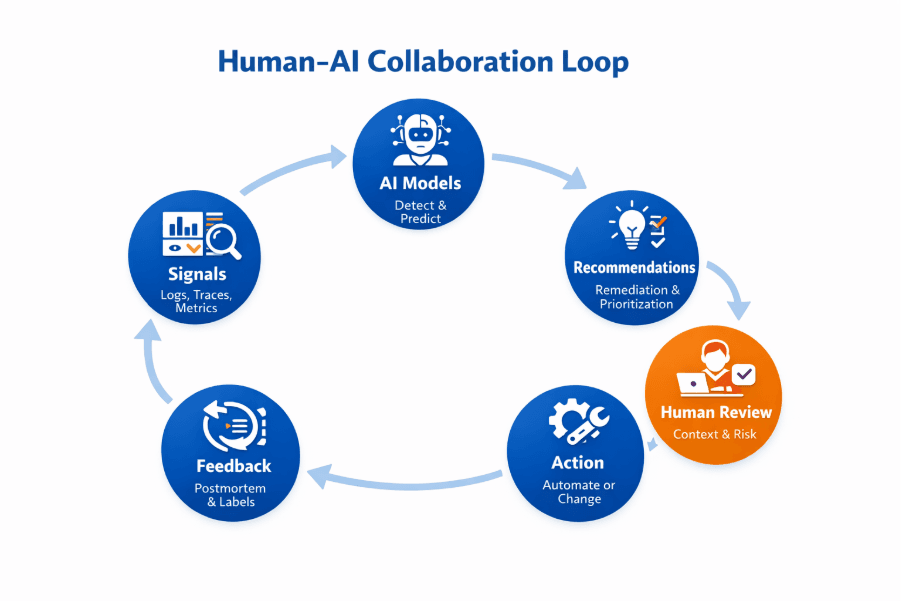
Operational excellence increasingly depends on rapid comprehension of complex data (logs, traces, metrics, security signals) and balanced decision‑making under uncertainty. Augmented intelligence supports both. Gartner reports that organizations with higher AI maturity keep 45% of their AI projects in production for at least three years more than double the rate of low‑maturity peers suggesting that when AI is embedded into workflows with proper governance and user trust, it sustains value over time. Furthermore, 57% of business units in high‑maturity organizations trust and are ready to use new AI solutions, reinforcing the premise that augmentation thrives where human users rely on AI recommendations yet retain decision control.
The Market Signal: Investment Is Following Augmentation
Spending patterns corroborate the structural shift from task automation to human‑AI collaboration. The augmented intelligence market is projected to grow from USD 41.87B in 2025 to USD 118.72B by 2030 (23.17% CAGR). This outlook highlights the pivot toward systems designed to complement, not replace, skilled practitioners. Notably, hybrid deployment is the fastest‑growing architecture, reflecting IT leaders’ need to balance latency, sovereignty, and cost, critical factors when pairing on‑prem telemetry with cloud‑scale models for augmentation at the edge and in the core.
What “Augmented” Looks Like in Day‑to‑Day IT
In incident response, augmented intelligence ingests vast volumes of signals, correlates probable root causes, and proposes prioritized actions. Engineers validate these suggestions against known system behaviors and business context, reducing mean time to remediate while minimizing false positives that fully automated rules might miss. Similar patterns hold in capacity planning (scenario simulations with human sign‑off), security operations (threat hypothesis generation with analyst validation), and software delivery (AI‑assisted code changes reviewed by maintainers). High‑performing organizations increasingly redesign workflows to capture these benefits, rather than merely bolting AI onto old processes. McKinsey observes that high performers use AI not only for efficiency but to transform workflows and enable innovation (64% report AI as an enabler of innovation), moving beyond narrow automation gains.
Productivity, But with Realistic Caveats
Enterprise leaders increasingly expect AI to drive innovation and displace narrow robotic process automation (RPA) in favor of more adaptive, context‑aware automation. In a 2025 global enterprise survey, 85% of leaders expected AI to drive innovation, and 70% believed AI‑based automation would overtake traditional RPA within three years. However, adoption remains non‑trivial: 75% reported difficulty adopting AI, and 69% said most AI projects don’t reach live operational use, underscoring the need for robust data foundations, governance, and change management for augmented approaches to stick.
These caveats align with broader market observations. Even as AI usage grows, many organizations remain in pilot or experimentation phases, indicating that impact depends on intentional scaling, precisely the realm where augmented intelligence, with humans in control, helps mitigate risk while building trust.
Governance, Trust, and the Data Foundation
Augmented intelligence is only as good as its data and its safeguards. Gartner’s analysis highlights data availability and quality as top challenges across maturity levels and identifies security threats and use‑case selection as persistent barriers. Addressing these issues requires clear governance (model lineage, access controls, audit trails), robust observability of both systems and models, and integrated review loops where human operators can override, annotate, and improve AI outputs. The organizations that keep AI projects alive for years do so by aligning technical feasibility with business value and by institutionalizing trust via metrics, dedicated AI leadership, and engineering discipline.
The Business Case: From Cost Savings to Resilience and Innovation
While early AI and automation programs emphasized cost reduction, the next wave of value is broader: service resilience, risk reduction, and faster delivery of new capabilities. The Stanford AI Index documents continued performance improvements on demanding benchmarks and notes the diffusion of AI into everyday operations across sectors, supporting the case that AI’s enterprise role is shifting from isolated pilots to embedded capabilities. In parallel, McKinsey’s survey indicates that high performers balance efficiency with growth and innovation objectives, using AI to re‑architect workflows rather than merely speed up existing ones. Together, these findings justify investment in augmented intelligence as a durable operating model, not a short‑term cost play.
Practical Steps for IT Leaders
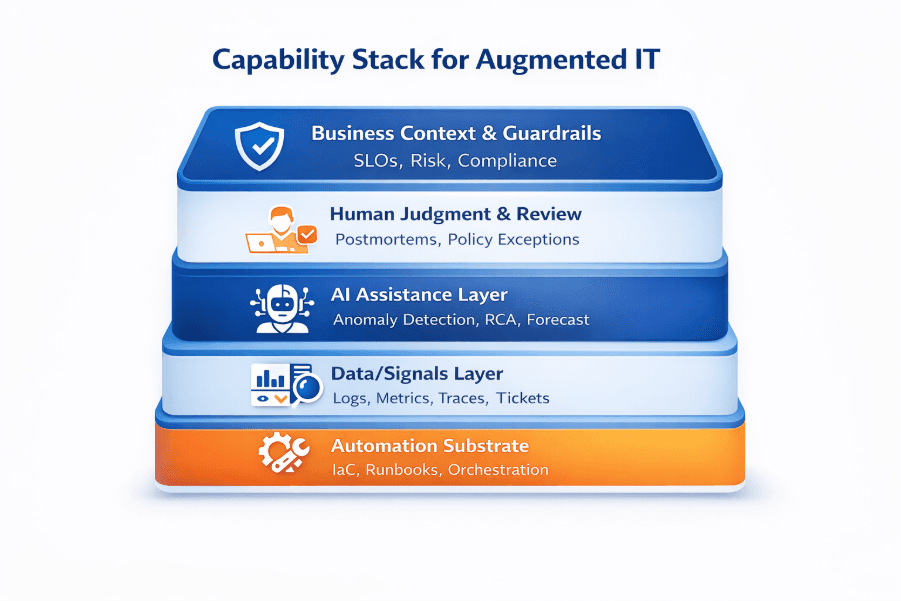
To realize augmented intelligence at scale, IT leaders can begin with three pragmatic moves. First, prioritize use cases where humans already make high‑stakes decisions under time pressure (e.g., incident response, threat hunting) and deploy AI as a recommendation engine, not an autonomous actor. This accelerates value while preserving control and trust, consistent with the patterns seen in high‑maturity organizations. Second, build the data and observability backbone, centralize telemetry, establish model observability, and ensure feedback capture from engineers into training and tuning loops. This directly addresses the data quality and availability concerns that otherwise stall adoption. Third, formalize governance and change management, including human‑in‑the‑loop policies, performance and bias reviews, and clear metrics for uptime, risk, and customer impact, aligning with research that shows scaled value comes with structured operating models.
The Standard, Not the Exception
The direction of travel is clear. Adoption and investment trends point to rising AI usage, while operational realities demand systems that enhance, not replace, human expertise. Market forecasts indicate robust growth for augmented intelligence platforms, and maturity studies show that organizations extracting durable value treat AI as a partner in decision‑making, embedded in resilient workflows. In short, the future of IT operations is not fully automated; it is intelligently augmented, a standard in which engineers leverage AI to comprehend complexity faster, act with more confidence, and continually improve outcomes in an environment where change is the only constant.



Real People, Real Replies.
That's how it usually goes, you reach out with a question or a rough idea, a real person at Aziro responds, and a conversation turns into something big.
Start yours with us.

Talk to us
+1 227 232 3176

Drop us a line at
info@aziro.com