Introduction
Imagine building a bridge without knowing who will cross it. That’s what happens when teams design products without understanding users. Empathy turns assumptions into alignment, it ensures we build for people, not for profiles. In modern IT-driven products, empathy isn’t a “soft skill theater.” It’s the foundation of business performance. According to Forrester and Gartner (2025), organizations embedding empathy into design achieve up to 60% higher financial performance, 1.4× better retention, and significantly faster onboarding compared to feature-led peers. Empathy mapping isn’t optional anymore—it’s a growth strategy.
Why Empathy Is a Business Competency—Not a Hobby
Think about buying a new phone purely by reading its spec sheet. On paper it looks perfect—but once you use it, the camera frustrates you, the charger doesn’t fit your adapter, and the interface feels alien. Technically sound, emotionally wrong. That’s what building products without empathy looks like.
Empathy bridges the gap between functionality and fulfilment.
In market-structure analysis terms (as discussed in ISB M3), empathy ensures we match perceived value with delivered experience. By mapping user frustrations and aspirations, product managers reduce “experience leakage”—the drop-off between a promised value proposition and what customers actually feel.
Example:
- Nintendo Wii succeeded not by out-teching Sony or Microsoft but by understanding that families wanted fun, inclusive play, not graphic intensity.
- LEGO’s turnaround came when it studied how children combined digital and physical creativity, leading to LEGO Mindstorms and LEGO Ideas.
Empathy isn’t “being nice.” It’s being precise about what really matters.
Building Personas That Reflect Reality
Personas aren’t glossy posters; they’re evidence-based hypotheses. A good persona blends demographic data (who), psychographic context (why), and behavioral patterns (how).
The Three Layers of Effective Personas
- Primary Persona: Core revenue or usage driver.
Example: “Priya, 38, utility-app user who values simplicity over rewards.” - Secondary Persona: Influencer or occasional user.
Example: “Arjun, 65, depends on assisted payments but values trust and security.” - Anti-Persona: Who you shouldn’t design for—helps prevent scope creep.
Fact Check:
According to Salesforce State of the Connected Customer (2024), 73 % of customers expect companies to understand their needs before they explain them. Personas operationalize that expectation.
Journey Mapping—The Heartbeat of Empathy
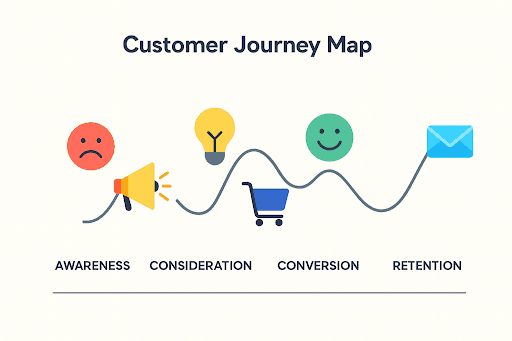
A customer journey map is empathy made visible.
It plots how users feel, think, and act at every touchpoint—from discovery to renewal.
Phases of a Journey Map:
- Awareness: Where users first hear of you.
- Consideration: How they evaluate your promise.
- Conversion: The trigger to act.
- Adoption: The first success moment.
- Retention: What keeps them returning.
By capturing emotions at each stage, product teams expose friction points.
Nielsen Norman Group calls this the “Pain → Gain” curve—each dip is an opportunity to design delight.
Case Study (C-Study):
(A hypothetical example mirroring real decision-making conflicts in product teams)
A utility platform serving senior citizens mapped their bill-payment journey.
Discovery showed users struggled with small fonts and too many clicks.
By simplifying screens and enabling one-tap payments, adoption rose by 22 %.
Practical Study (P-Study):
(A hypothetical example mirroring real decision-making conflicts in product teams)
When teams design for an “average user,” they design for no one.
Edge cases dominate, mainstream users churn.
Empathy prevents this by anchoring design decisions to real user diversity, not imaginary averages.
AI as an Empathy Amplifier
AI can’t feel, but it can reveal.
Today’s product managers use AI tools to scale empathy:
| Area | How AI Helps | Example Tool |
|---|---|---|
| Persona Discovery | Cluster users based on behavior & sentiment | Amplitude Personas |
| Journey Mapping | Heat-map frustration points via clickstream + NLP | FullStory, Hotjar |
| Voice of Customer Mining | Extract pain themes from tickets & reviews | ChatGPT + Zendesk integration |
| Accessibility Testing | Simulate usage for differently-abled personas | Fable, Microsoft Accessibility Insights |
According to Gartner (2024), organizations using AI-assisted journey analytics see 27 % faster issue detection and 19 % higher retention from UX improvements.
AI doesn’t replace human empathy—it scales it. It helps product teams listen better, faster, and at scale.
Key Takeaways
- Empathy isn’t emotion—it’s precision in understanding real pain points.
- Personas guide who to build for; journey maps reveal where to focus first.
- AI turns qualitative insight into quantifiable action.
- When empathy drives design, retention replaces re-acquisition.
As IDEO’s Tim Brown says:
“Empathy is the world’s most powerful design tool—because it reminds us that our users are human first.”
Next in the Series
Once you truly understand your user, the next step is transforming empathy into solutions.
Stay tuned for Post 5 – “Design Thinking, but Make It Real.”
By Deep Verma | Exploring product management beyond the backlog