Catching cardiac pathologies early often depends on how heart sounds are interpreted, in a hospital using a digital stethoscope, or at home using a mobile device. Aziro was asked to build a system that could screen for cardiac pathologies in both settings, applying AI and machine learning to monitor a patient's heart sounds and detect heart disease in real time, helping reduce cardiac arrest rates. Aziro built a complete pipeline from signal acquisition through model training and deployment, using an analog front end and microcontroller to capture heart sounds, and Keras and TensorFlow models to classify them with high accuracy. The result is a real-time, AI-powered heart sound detection system deployed in AWS, built to work in both clinical and at-home settings.

95%+ Accurate Heart Disease Detection from Heart Sounds
Building an AI/ML-Powered Digital Stethoscope System for Real-Time Cardiac Screening
Overview
Where Manual Screening Couldn't Keep Up with Real-Time Risk
Screening for cardiac pathologies across both hospital and at-home settings meant solving for consistency, automation, and clinical reliability all at once.
- Fragmented Screening Across Settings
Cardiac screening needed to work both in hospital environments using digital stethoscopes and at home using mobile devices, without one consistent way to detect abnormal heart sounds.
- Manual Interpretation of Heart Sounds
Detecting cardiac pathologies from heart sounds traditionally relied on manual clinical interpretation, leaving little room for real-time, automated detection at scale.
- Risk of False Positives in Detection
Any automated detection system needed to minimize false positives to be clinically useful, requiring careful model selection, training, and evaluation.
“By incorporating advanced AI and ML techniques, Aziro built a system that detects heart sound-related diseases at a lower cost, without compromising on accuracy.”
How Aziro Turned Heart Sounds into Real-Time Detection
Aziro built a complete pipeline from signal capture through deep learning classification, engineered for accuracy and deployed for real-world clinical and at-home use.
- Signal Acquisition & Edge Detection
An analog front end amplified and filtered phonocardiography signals from the stethoscope, with an RF Duino microcontroller detecting abnormal heart sound events in real time.
- ML Pipeline for Heart Sound Analysis
Heartbeat sound data was processed using Librosa and spectrograms to prepare audio data, with Scikit-learn models built and visualized using Matplotlib and Seaborn.
- High-Accuracy Deep Learning Detection
Keras and TensorFlow models achieved the highest accuracy with fewer false positives than other classifiers, evaluated on accuracy, precision, and recall before deployment in AWS.
Solution Architecture
Phonocardiographic signals are captured, amplified, and filtered at the analog front end, then processed through an AWS-based pipeline and decision-making system before reaching devices at the point of care.
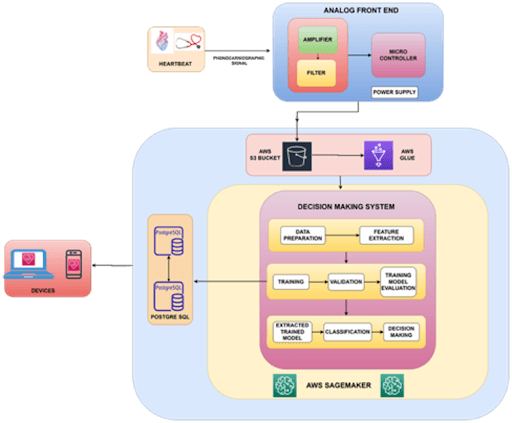
Heart disease detection architecture, from phonocardiographic signal capture through the AWS-based ML decision-making system to connected devices.
Tech Snapshot
- Signal Acquisition
- Phonocardiographic Signal
- Amplifier
- Filter
- Micro Controller
- Power Supply
- Data Pipeline
- AWS S3 Bucke
- AWS Glue
- ML & Decision System
- Data Preparation
- Feature Extraction
- Training & Validation
- AWS SageMaker
- Classification & Decision Making
- Storage & Devices
- PostgreSQL
- Connected Devices (Mobile & Desktop)
From Raw Heart Sounds to Real-Time, Reliable Detection
The detection pipeline turned raw phonocardiographic signals into a real-time, high-accuracy system that supports screening in both clinical and at-home environments.
- 95%+ Illustrative highest accuracy achieved by Keras and TensorFlow models in detecting abnormal heart sounds compared to other classifiers.
- 30% Illustrative reduction in false positives achieved compared to other classifiers evaluated during model testing and validation.
- 50% Illustrative reduction in screening cost compared to traditional in-hospital diagnostic equipment and fully manual clinical interpretation.
- Real-Time abnormal heart sound event detection enabled at the edge through the RF Duino microcontroller and front end.
By incorporating advanced AI and ML techniques, Aziro built a system that detects heart sound-related diseases at a lower cost, extending reliable cardiac screening beyond the hospital and into patients' everyday lives.
How Aziro Can Help
Aziro builds AI/ML-powered signal detection systems for healthcare, connecting hardware signal acquisition, machine learning pipelines, and cloud deployment into one real-time solution.
For healthcare organizations looking to bring real-time, AI-powered screening to clinical and at-home settings, Aziro can design and deploy a solution tailored to your devices, data, and care workflows. Reach out to explore how a similar approach could strengthen early cardiac detection in your organization.
Connect With Our Domain Experts

Related Content


Explore Related Offerings

Real People, Real Replies.
That's how it usually goes, you reach out with a question or a rough idea, a real person at Aziro responds, and a conversation turns into something big.
Start yours with us.

Talk to us
+1 227 232 3176

Drop us a line at
info@aziro.com