Tag Archive

Below you'll find a list of all posts that have been tagged as "devops"
blogImage

Best DevOps Services Every Engineering Team Should Consider

Nowadays, DevOps is not just a methodology, but it’s a proven approach to drive effective engineering outcomes and faster releases. As system and product cycles speed up, teams are delivering faster, automated, and reliable infrastructure. According to recent data,50% of DevOps adopters are now elite or high performers, and 30% improvement over the previous years. This data highlights increased adoption, along with a growing maturity across automation, pipelines, collaboration, and infrastructure models. For engineering teams willing to grow their teams and increase deployment frequency, choosing the right DevOps services is significant. In this blog, we will explore the best services that are transforming engineering teams to build scalable and secure delivery pipelines.7 Best DevOps Services For Evolving Engineering TeamsHere is the list of the top 8 services designed to help teams stay flexible, deployment-ready, and agile. From CI/CD and version control systems to monitoring and logging tools, these services aren’t just trends — they are the foundation of scalable and reliable software. If your DevOps team is evolving, these are the services you should consider.Continuous Integration/Continuous Deployment (CI/CD)CI/CD is a significant feature of modern DevOps practices, automating the integration and delivery of code. It enables the team to test and release applications faster than before. CI detects errors and also enhances the quality of the code. However, CD allows the code to get into a deployable state constantly for every small change. Here are several renowned CI/CD tools mentioned. Let’s discuss them one by one:GitHub ActionsA powerful CI/CD platform or tool built into GitHub, which enables developers to automate software development workflows. GitHub Actions allows users to build, test, and deploy software applications directly from GitHub. Additionally, it also supports matrix builds and native integration with GitHub repositories.JenkinsJenkins is a prominent and open-source automation server and a widely used CI/CD platform. It is used for the automation of software development, such as building, testing, and deploying, enabling streamlined CI/CD workflows. Furthermore, this CI/CD tool supports several version control tools like CVS, Subversion, AccuRev, Git, RTC, Mercurial, ClearCase, and Perforce.Circle CICircleCI is another CI/CD platform that seamlessly implements DevOps practices. This CI/CD platform provides both self-hosted and cloud solutions. It also automates the software development process to assist development teams in releasing code efficiently.Several DevOps consulting companies identify these tools as a significant component for development teams willing to implement CI/CD pipelines.Version Control SystemsVersion Control Systems(VCS) is a DevOps service tool that easily identifies and manages changes to files or even sets of files. It collaborates, maintains changes, and reverts to previous versions. With VCS, you and your development team can work on the same project simultaneously, concurrently, and without any conflict.GitHubGitHub is a Git-based developer platform that offers collaborative features like pull requests, issue tracking, and project boards. With the help of GitHub, developers can conveniently create, store, share, and manage software code. In addition, it also supports both public and private repositories.GitLabGitLab is an open-source code repository platform or tool used for both DevOps and DevSecOps projects. Users can use it both as a commercial and a community edition. It brings all the development, security, and operations capabilities into one single platform with a unified data storage.Infrastructure as Code (IaC)Infrastructure as Code (IAC) is used to create environments mainly for infrastructure automation. It is a process of managing, provisioning, and supporting IT infrastructure using code rather than manual processes and settings. IAC also easily builds, tests, and deploys software applications.TerraformTerraform is one of the prominent and open-source IaC tools that is used to define and provision infrastructure with human-readable configuration files. It also uses various providers to interact with private clouds along with several cloud platforms, including Google Cloud, AWS, and Microsoft Azure.AWS CloudFormationAWS CloudFormation is a service offered by AWS that allows users to define and manage infrastructure resources in an automated way. It uses templates, which are mainly IaC, to define the desired state of AWS resources. Moreover, it creates and manages stacks, which are essentially collections of AWS resources.Configuration ManagementConfiguration Management is a process of maintaining both software and hardware systems in a desired state. It also ensures that systems perform consistently, reliably, and meet their desired purpose over time. Furthermore, it restricts troubleshooting and costly rework to save resources as well as time.PuppetPuppet is a popular configuration management tool that is best for managing the stages of the IT infrastructure. It enables administrators to define the ideal state of their infrastructure. Also, this tool assures that systems are configured to match the desired state.ChefChef is another configuration management tool that integrates with various cloud-based platforms such as Google Cloud, Oracle Cloud, IBM Cloud, Microsoft Azure, and so on. Also, this tool seamlessly converts infrastructure to code.Cloud Infrastructure ManagementCloud Infrastructure Management conveniently allocates, delivers, and manages cloud computing resources. It allows businesses to scale their cloud resources up or down to meet their organization’s needs. Additionally, it also uses code to define and manage cloud infrastructure, which later enables automation and consistency.AWSAmazon Web Services (AWS) is one of the most prominent cloud platforms which can be accessed by individuals, companies, and governments. It offers various cloud services like compute, storage, analytics, databases, networking, and so on.Google CloudGoogle Cloud is another cloud platform offered by Google that enables both individuals and businesses to run applications, store data, and seamlessly manage workloads. It also provides environments like serverless computing, infrastructure as a service, and platform as a service.ContainerizationContainerization is an application-level virtualization, allowing software applications to run in isolated user spaces, which are called containers in both cloud and non-cloud environments. It is generally lightweight and needs very few resources as compared to virtual machines.DockerDocker is an open-source platform that allows developers to deliver software in packages, which are called containers. Moreover, it helps developers to build lightweight and portable containers across various environments.OrchestrationOrchestration tools are a well-known orchestration tool that easily coordinates and manages several automated tasks and workflows across various applications. It minimizes human error and manual intervention by seamlessly automating workflows. Also, it is ideal for growing businesses, as it can easily handle large-scale operations.KubernetesKubernetes is an open-source orchestration tool that is specially designed to automate the software deployment, scaling, and management of applications. This tool allocates resources to containers based on their needs, to ensure that all the containers have the resources they require to run.Wrapping UpEngineering teams who are willing to deliver software fast and safely should choose the right DevOps services. From streamlining CI/CD tools and managing infrastructure as code to orchestration and cloud infrastructure management, these tools play a significant role in software delivery practices. Apart from these services, there are several other services also that are mentioned in this blog, which allow teams to maintain operational resilience, enhance collaboration, and automate processes.

Aziro Marketing

blogImage

Your 5 Step Guide to Agile Implementation

Software development using agile methodology has been widely advocated as the best. It is synonymous with a faster and leaner process that lets teams achieve results sooner and at a higher frequency. This trend however seems to have stuck only with smaller organizations and startups. Enterprises are still skeptical about adopting and doing justice to the manifesto guidelines. At most, they let smaller software development teams to adopt Agile methods and that’s where it stops. Experts reveal that enterprises are convinced that working with Agile is only beneficial for smaller teams because of their horizontal hierarchy and constant dialog with clients. These are practically unheard of with larger enterprises. And also there are doubts about the scalability of Scrum. While this is true to some extent, it is not completely true. Enterprises can, by all means merge the benefits of agile development with other enterprise functions and scale the approach for the organization’s advantage. Misconceptions about new technology is always a given. With Agile too, misconceptions and apprehensions are widespread in the industry leading to underutilization of a disruptive methodology like Agile. 1. Challenges in adopting Agile Love for documentation: Many professionals have the wrong notion that software development is effective only when it is based on producing comprehensive and detailed requirement and design documents. In contrast to this school of thought, Agile methods focus on code development over creating heavy duty documentation. There is a need to educate people about the agile approach to documentation and adopting the ‘document as needed’ method. Limited skills: After years of developing software using limited methods results in people who are experts in certain technology while lacking in other methods. For instance, project managers without an understanding of the underlying technologies used by their teams, programmers with no analysis and design modelling skills cannot be effective in delivering high quality software. To solve this problem professionals should train to become generalizing specialists so that they have specialized skills in one or more areas as well as basic understanding of the technical and business aspects of software development. Closed mindedness: Some software professionals do not believe in investing time and energy to learn about upcoming and promising methodologies. These people can be broadly segregated as; people who perceive agile methods as simple code-and-fix in disguise, and others who have adopted an anti-agile attitude. It is vital to actively educate these people about the advantages of agile methodologies. Such an attitude restricts the optimization of Agile technology thus rendering software development at the mercy of age old methods. A straight way of dealing with such people can be by teaching new approaches to new technology. This would allow smooth introduction of agile practices. Linear thinking: Many IT professionals have become accustomed to typical approaches which makes them unreceptive to new and evolutionary approaches. This can be attributed to the fact that the past 40 years have been dominated by software development methodologies using serial approaches. Such workers want to identify the complete requirements first, then design the system, and only after that start coding. Such people need to be given appropriate training, enough time, and targeted mentoring to learn the principles of agile development. At the same time, one should be vigilant to make sure that the serial mind-set does not hamper introduction and sustenance of agile practices in the enterprise. 2. Adopting Agile enterprise-wide To deliver the best results using Agile it is essential to understand how it impacts the enterprise. Agile affects the working of a system from its roots. It is important for a business to understand the changes that would be expected. With Agile’s recent rise in popularity, organizational integration of its methodologies is already becoming more common. The question remains: How can enterprises make the move as smooth and secure as possible? Approaches for enterprise level adoption of Agile can be broadly classified as- Top-down and Bottom-up. In the former approach, Agile is initiated by senior management and the latter involves developers and testers manning the process. Agile software development practices entail a major cultural trimming for an enterprise which calls for a coordinated change throughout the enterprise, not just at the top or bottom. For a seamless transition, one must consider strategies that involves participation from the developers, testers and leadership in an effectively collaborative discipline. 3. Best practices for a smooth Agile development process- Agile methodologies are emerging as the key to flexible, responsive software engineering. However, this approach – which emphasizes face-to-face communication and close interaction between teams – isn’t envisioned as a reality in large enterprises. This can be negated by adopting and adhering to some basic principles that work for your organization. A diligent indoctrination of Agile principles in your regular engagement and delivery models will help you get the best possible results from your teams- An iterative development approach with short sprints of 2-4 weeks Frequent builds and continuous integration Daily standup meetings and weekly or bi-weekly engineering meetings Effective use of tools for Agile project management, issue tracking, build and test automation Strong documentation and code commenting Test driven development, if applicable 4. Some Scrum Best Practices Well-defined product backlog Sprint planning meetings Effective daily scrums Optimal communication with questions & concerns raised early in the sprint Improvements with each sprint review Leadership elements internally and externally within teams 5. Choose the right Agile partner Scaling Agile is not an impossible task. With a well laid out strategy and workflow you can introduce employees to the Agile work culture. Agile software development delivers ROI once you have effectively and steadily on boarded employees on to the program. However, if this is the first time that you’re working with agile, then it is essential to work with an expert. Consider working with service providers having Agile expertise. Some things that you must expect from such service providers include: Assured high-quality delivery: Consider high quality results from experienced and specialist engineers. Integrated cohesive Interactions: A smart agile worker values continuous innovation and constant interaction with client, project leaders, and team members for contact revaluation of the process Faster results, responsive to change: Expect a responsive and highly dynamic team when you are working with a vendor Personalized delivery: Unlike startups, Agility across an enterprise requires more detailed and panned out structure. Does your vendor understand you? Are they focusing on scaling agile on a constant basis? Often large enterprises find it feasible to work closely with companies adept at Agile or DevOps work culture. Doing so gives them the much needed gradual exposure to the new culture without disturbing their own.

Aziro Marketing

blogImage

Make Your Docker Setup a Success with these 4 Key Components

Building a web application to deploy on an infrastructure, which needs to be on HA mode, while being consistent across all zones is a key challenge. Thanks to the efforts of enthusiasts and technologists, we now have the answer to this challenge in the form of Docker Swarm. A Docker Container architecture will allow the deployment of web applications on the required infrastructure.As a part of this write-up, I will run you through Docker Setup while emphasizing on the challenges and key concern on deploying the web applications on such infrastructure; such that it is highly available, load balanced and deployable quickly, every time changes or releases take place. This may not sound easy, but we gave it a shot, and we were not disappointed.Background:The Docker family is hardly restrained by environments. When we started analyzing all container and cluster technologies, the main consideration was easy to use and simple to implement. With the latest version of Docker swarm, that became possible. Though swarm seemed to lack potential in the initial phase, it matured over time and dispels any doubts that may have been expressed in the past.Docker swarm:Docker swarm is a great cluster technology from Docker. Unlike its competitors like Kubernetes, Mesos and CoreOS Fleet, Swarm is relatively easier to work with. Swarm holds the clusters of all similar functions and communicates between them.So after much POC and analysis, we decided to go ahead with Docker, we got our web application up and running, and introduced it to the Docker family. We realized that the web application might take some time to adjust in the container deployment so we considered revisiting the design and testing the compatibility; but thanks to dev community, the required precautions were already taken care of while development.The web application is a typical 3-tier application – client, server, and database.Key Challenges of Web Application DeploymentSlow deploymentHAoad balancerNow let’s Docker-Implementation Steps:Create a package using Continuous Integration.Once the web application is built and packaged, modify the Docker file and append the latest version of the web app built using Jenkins. This was automated E2E.Create the image using Docker file and deploy it to container. Start the container and verify whether the application is up and running.The UI cluster exclusively held the UI container, and the DB cluster was holding all DB containers. Docker swarm made the clustering very easy and communication between each container occurred without any hurdle.Docker Setup:Components:Docker containers, Docker swarm, UCP, load balancer (nginx)In total there are 10 containers deployed which communicate with DB nodes and fetch the data as per requirement. The containers we deployed were slightly short of 50 for this setup. Docker UCP is an amazing UI for managing E2E containers orchestration. UCP is not only responsible for on-premise container management, but also a solution for VPC (virtual private cloud). It manages all containers regardless of infrastructure and application running on any instance.UCP comes in two flavors: open source as well as enterprise solution.Port mappings:The application is configured to listen in on port 8080, which gets redirected from the load balancer. The URL remains same and common, but eventually, it gets mapped to the available container at that time and the UI is visible to the end user.Key Docker Setup concerns:One concern we faced with swarm is that the existing containers cannot be registered to newly created Docker swarm setup.We had to create the Docker swarm setup first and create the images / containers in the respective cluster.UI nodes will be deployed in UI cluster and DB nodes are deployed in DB cluster.Docker UCP and nginx load balancer are deployed on single host which are exposed to the external network.mysqlDB is deployed on DB cluster.Following is the high level workflow and design:

Aziro Marketing

blogImage

Making DevOps Sensible with Assembly Lines

DevOps heralded an era of cutting edge practices in software development and delivery via Continuous Integration (CI) Pipelines. CI made DevOps an epitome of software development and automation, entailing the finest agile methodologies. But, the need for quicker development, testing, and deployment is a never-ending process. This need is pushing back the CI and creating a space for a sharper automation practice, which runs beyond the usual bits and pieces automation. This concept is known as DevOps Assembly Lines.Borrowing inspiration from Automobile IndustryThe concept of assembly lines was first started at Ford Plant in the early 20th century – the idea improved continuously and today is powered via automation. Initially, the parts of the automobiles were manufactured and assembled manually. This was followed by automation in manufacturing, while the assembly was manual. So, there were gaps to be addressed for efficiency, workflow optimization, and speed. The gaps were addressed by automating the assembly of parts. Something similar is happening in the SDLC via DevOps Assembly Lines.Organizations that implement advanced practices of DevOps follow a standardized and methodological process throughout the teams. As a result, these organization experiences fast-flowing CI pipelines, rapid delivery, and top quality.A silo approach that blurs transparencyFollowing the DevOps scheme empowers employees to deliver their tasks efficiently and contribute to the desired output of their team. Many such teams within a software development process are leveraging automation principles. The only concern is that this teamwork is in silos hindering overall visibility into other teams’ productivity, performance, and quality. Therefore, the end product falls shorts of desired expectations – often leaving teams perplexed and demotivated. This difference in DevOps maturity within different teams in a software development environment calls for a uniform Assembly Line.Assembly Lines – triggering de-silo of fragmented teamsCI pipelines consist of a host of automated activities that are relevant to individual stages in the software lifecycle. Which means there are a number of CI pipelines operating simultaneously; but, it is fragmented within SDLC. Assembly Lines is an automated conflation of such CI pipelines towards accelerating a software product’s development and deployment time. DevOps Assembly Line automates activities like continuous integration in the production environment, configuration management and server patching for infrastructure managers, reusable automation scripts in the testing environment, and code as monitoring scripts for security purposes.Bridging the gap between workflows, tools and platformsDevOps Assembly Lines creates a perfect bridge, finely binding standalone workflows, and automated tools and platforms. This way, it establishes a smoothly integrated chain of deployment pipeline optimized for the efficient delivery of software products. The good part is it creates an island of connected and automated tools and platforms; these platforms belong to different vendors and are that gel together easily. Assembly Lines eliminates the gap between manual and automated tasks. It brings QAs, developers, operations teams, SecOps, release management teams, etc. on a single plane to enable a streamlined and uni-directional strategy for product delivery.Managed platform as a service approach for managementDevOps Assembly Lines exhibits an interconnected web of multiple CI pipelines, which entail numerous automated workflows. This makes the management of Assembly Lines a bit tricky. Therefore, Organizations can leverage a managed services portal that streamlines all the activities across the DevOps Assembly Lines.Installing a DevOps platform will centralize the activities of Assembly Lines and streamline a host of workflows. It will offer a unified experience to multiple DevOps teams and also help operate a low cost and fast-paced Assembly Lines. A DevOps platform would also entail different tools from multiple vendors that could work in tandem.The whole idea behind installing Assembly Lines is to establish a collaborative auto-mode within diverse activities of SDLC. A centralized, on-demand platform could help get started with pre-integrated tools, that could manage automated deployment.A team of operators, either in-house or via a support partner, could handle this platform. This way, there will be smooth functioning across groups, and on-demand requests for any issues that could be addressed immediately. The platform will invariably help DevOps architects to concentrate on productive parts – while maintenance is taken care of behind the scenes. Further, it would allow teams to look beyond their core activities (a key goal of Assembly Lines) and absorb the status of overall team productivity. The transparency will give them an idea of existing hindrances, performances, productivity, and expected quality. In accordance, they could take corrective measures.Future AheadCI pipelines are helpful for rapid product development and deployment. But, considering the graph of rising expectation in quality and feature enablement and considering the time-to-market requirement, the CI pipelines do not fit the bill. Further, the issue of configuration management is too complicated for CI pipelines to handle. Therefore, the next logical step is to embrace DevOps Assembly Lines. And the importance of a centralized management platform to drive consistency, scalability, and transparency via Assembly Lines should not be undermined.

Aziro Marketing

blogImage

Chef Knife Plugin for Windows Azure (IAAS)

Chef is an open-source systems management and cloud infrastructure automation framework created by Opscode. It helps in managing your IT infrastructure and applications as code. It gives you a way to automate your infrastructure and processes. Knife is a CLI to create, update, search and delete the entities or manage actions on entities in your infrastructure like node (hosts), cloud resources, metadata (roles, environments) and code for infrastructure (recipes, cookbooks), etc. A Knife plug-in is a set of one (or more) subcommands that can be added to Knife to support additional functionality that is not built-in to the base set of Knife subcommands. The knife azure is a knife plugin which helps you automate virtual machine provisioning in Windows Azure and bootstrapping it. This article talks about using Chef and knife-azure plugin to provision Windows/Linux virtual machines in Windows Azure and bootstrapping the virtual machine. Understanding Windows Azure (IaaS): To deploy a Virtual Machine in a region (or service location) in Azure, all the components shown described above have to be created; A Virtual Machine is associated with a DNS (or cloud service). Multiple Virtual Machines can be associated with a single DNS with load-balancing enabled on certain ports (eg. 80, 443 etc). A Virtual Machine has a storage account associated with it which storages OS and Data disks A X509 certificate is required for password-less SSH authentication on Linux VMs and HTTPS-based WinRM authentication for Windows VMs. A service location is a geographic region in which to create the VMs, Storage accounts etc The Storage Account The storage account holds all the disks (OS as well as data). It is recommended that you create a storage account in a region and use it for the VMs in that region. If you provide the option –azure-storage-account, knife-azure plugin creates a new storage account with that name if it doesnt already exist. It uses this storage account to create your VM. If you do not specify the option, then the plugin checks for an existing storage account in the service location you have mentioned (using option –service-location). If no storage account exists in your location, then it creates a new storage with name prefixed with the azure-dns-name and suffixed with a 10 char random string. Azure Virtual Machine This is also called as Role(specified using option –azure-vm-name). If you do not specify the VM name, the default VM name is taken from the DNS name( specified using option –azure-dns-name). The VM name should be unique within a deployment. An Azure VM is analogous to the Amazon EC2 instance. Like an instance in Amazon is created from an AMI, you can create an Azure VM from the stock images provided by Azure. You can also create your own images and save them against your subscription. Azure DNS This is also called as Hosted Service or Cloud Service. It is a container for your application deployments in Azure( specified using option –azure-dns-name). A cloud service is created for each azure deployment. You can have multiple VMs(Roles) within a deployment with certain ports configured as load-balanced. OS Disk A disk is a VHD that you can boot and mount as a running version of an operating system. After an image is provisioned, it becomes a disk. A disk is always created when you use an image to create a virtual machine. Any VHD that is attached to virtualized hardware and that is running as part of a service is a disk. An existing OS Disk can be used (specified using option –azure-os-disk-name ) to create a VM as well. Certificates For SSH login without password, an X509 Certificate needs to be uploaded to the Azure DNS/Hosted service. As an end user, simply specify your private RSA key using –identity-file option and the knife plugin takes care of generating a X509 certificate. The virtual machine which is spawned then contains the required SSH thumbprint. I am text block. Click edit button to change this text. Lorem ipsum dolor sit amet, consectetur adipiscing elit. Ut elit tellus, luctus nec ullamcorper mattis, pulvinar dapibus leo. Gem Install Run the command gem install knife-azure Install from Source Code To get the latest changes in the knife azure plugin, download the source code, build and install the plugin: 1. Uninstall any existing versions $ gem uninstall knife-azure Successfully uninstalled knife-azure-1.2.0 2. Clone the git repo and build the code $ git clone https://github.com/opscode/knife-azure $ cd knife-azure $ gem build knife-azure.gemspec WARNING: description and summary are identical Successfully built RubyGem Name: knife-azure Version: 1.2.0 File: knife-azure-1.2.0.gem 3. Install the gem $ gem install knife-azure-1.2.0.gem Successfully installed knife-azure-1.2.0 1 gem installed Installing ri documentation for knife-azure-1.2.0... Building YARD (yri) index for knife-azure-1.2.0... Installing RDoc documentation for knife-azure-1.2.0... 4. Verify your installation $ gem list | grep azure knife-azure (1.2.0) To provision a VM in Windows Azure and bootstrap using knife, Firstly, create a new windows azure account: at this link and secondly, download the publish settings file fromhttps://manage.windowsazure.com/publishsettings The publish settings file contains certificates used to sign all the HTTP requests (REST APIs). Azure supports two modes to create virtual machines – quick create and advanced. Azure VM Quick Create You can create a server with minimal configuration. On the Azure Management Portal, this corresponds to the “Quick Create – Virtual Machine” workflow. The corresponding sample command for quick create for a small Windows instance is: knife azure server create --azure-publish-settings-file '/path/to/your/cert.publishsettingsfile' --azure-dns-name 'myservice' --azure-source-image 'windows-image-name' --winrm-password 'jetstream@123' --template-file 'windows-chef-client-msi.erb' --azure-service-location "West US" Azure VM Advanced Create You can set various other options in the advanced create including service location or region, storage-account, VM name etc. The corresponding command to create a Linux instance with advanced options is: knife azure server create --azure-publish-settings-file "path/to/your/publish/settings/file" --azure-vm-size Medium --azure-dns-name "HelloAzureDNS" --azure-service-location "West US" --azure-vm-name 'myvm01' --azure-source-image "b39f27a8b8c64d52b05eac6a62ebad85__Ubuntu-13_04-amd64-server-20130423-en-us-30GB" --azure-storage-account "helloazurestorage1" --ssh-user "helloazure" --identity-file "path/to/your/rsa/pvt/key" To create a VM and connect it to an existing DNS/service, you can use a command as below: knife azure server create --azure-publish-settings-file "path/to/your/publish/settings/file" --azure-connect-to-existing-dns --azure-dns-name 'myservice' --azure-vm-name 'myvm02' --azure-service-location 'West US' --azure-source-image 'source-image-name' --ssh-user 'jetstream' --ssh-password 'jetstream@123' List available Images: knife azure image list List currently available Virtual Machines: knife azure server list Delete and Clean up a Virtual Machine: knife azure server delete --azure-dns-name myvm02 'myservice' --chef-node-name 'myvm02' --purge This post is meant to explain the basics and usage for knife-azure.

Aziro Marketing

blogImage

Kubernetes – Bridging the Gap between 5G and Intelligent Edge Computing

PrologueIn the era of digital transformation, the 5G network is a leap forward. But frankly, the tall promises of the 5G network are cornering the edge computing technology to democratize data at a granular level. To add to the vows, 5G also demands that edge computing enhances performance and latency while slashing the cost. Kubernetes – an open-source container-orchestration is a dealmaker between 5G and edge computing.In this blog, you will read:A decade defined by the cloudThe legend of cloud-native ContainersThe rise of Container Network Functions (CNFs)Edge computing must reinvent the wheelKubernetes – powering 5G at the edgeKubeEdge – giving an edge to KubernetesA decade defined by the cloudWhat oil is to the automobile industry, the cloud is to Information Technology (IT) industry. Cloud revolutionized the tech space by making data available at your fingertips. Amazon’s Elastic Compute Cloud (EC2) planted the seed of the cloud somewhere in the early 2000s. Google Cloud and Microsoft Azure followed this. However, the real growth of cloud technology skyrocketed only after 2010-2012.Numbers underlining the future trends– Per Cisco, cloud computing will process more than 90 percent of the workloads in 2021– PerRightScale, the business run around 41 percent workloads in private cloud and 38 percent in the public cloud– Per Cisco, 75 percent of all compute instance and cloud workloads will be SaaS by the end of 2021The legend of cloud-native ContainersThe advent of cloud-native is a hallmark of evolutionary development in the cloud ecosystem. The fundamental nature of the architecture of cloud-native is the abstraction of multiple layers of the infrastructure. This means a cloud-native architect has to define those layers via code. And when coding, one gets a chance to include top functionalities to maximize the value of the business. Cloud-native also empowers coders to create scripts for infrastructure scalability.Cloud-native container tech is making a noteworthy contribution to the future growth of the cloud-native ecosystem. It is playing a more significant role in enabling capabilities of the 5G architecture in real-time. With container-focused web services, 5G network companies can achieve resource isolation and reproducibility to drive resiliency and faster deployment. Containers make the process of deployment less intricate, which powers the 5G infrastructure to scale data requirements spanning cloud networks. Organizations can leverage Containers to process data and compute it on a massive scale.A conflation of Containers and DevOps work magic for 5G. Bringing these loosely coupled services will help 5G providers to automate application deployment, receive feedback swiftly, eliminate bottlenecks, and achieve a self-paced continuous improvement mechanism. They can provision resources on-demand with unified management across a hybrid cloud.The fire of cloud-native is ignited in the telecom sector. The coming decade – 2021-2030, will witness it spread like wildfire.The rise of the Container Network Functions (CNFs)We witnessed the rise of Container Network Functions (CNFs), while network providers were using containers with VMware and virtual network functions (VNF). CNFs are functions of a network that can run on Kubernetes across multi-cloud and/or hybrid cloud infrastructure. CNFs are ultra-lightweight compared to VNFs, which traditionally operate in the VMware environment. This makes CNFs super portable and scalable. But, the underlining factor in the CNF architecture is that it is deployable over a bare metal server that brings down the cost dramatically.5G – the next wave in the telecom sector promises to offer next-gen services entailing automation, elasticity, and transparency. Looking at the requirement micro-segmented architectures, VNF (VMware environment) would not be an ideal choice for 5G providers. Logically, the adoption of CNFs is a natural step forward. Of course, doing away entirely with VMware isn’t anytime on the board. Therefore, a hybrid model of VNF and CNF sounds good.Recently, Intel, in collaboration with Red Hat, created a cloud-based onboarding service and test bed to conflate CNF (containerized environment) and VNF (VMware environment). The test bed is expected to enhance compatibility between CNF and VNF and slash the deployment time. The architecture looks like the image below.Edge computing must reinvent the wheelMultiple devices generate a massive amount of data concurrently. To enable cloud centers to process such data is a herculean task. Edge computing architecture puts infrastructure close to data devices within a distributed environment that results in faster response time and lower latency. Edge computing’s local processing of data simplifies the process and reduces the overall costs. Edge computing has been working as a catalyst for the telecommunication industry to date. However, with 5G in the picture, the boundaries are all set to push.The rising popularity of the 5G network is putting a thrust on intuitive experiences in real-time. 5G catapults the speed of the broadband by up to 10x and plummets the device density by around a million devices/sq.km. For this, 5G requires ultra-low latency, which can be created by a digital infrastructure powered by edge computing.Honestly, edge computing must start flapping its wings for the success of the 5G network. It must ensure– Better device management– Lesser resource utilization– More lightweight capabilities– Ultra-low latency– Increased security blanket and data transfer reliabilityKubernetes – powering 5G at the edge“Kubernetes (K8s) is an open-source system for automating deployment, scaling, and management of containerized applications. It groups containers that make up an application into logical units for easy management and discovery.” Kubernetes.ioKubernetes streamlines the underlying compute spanning distributed environment and imparts consistency at the edge. Kubernetes helps network providers maximize the value of Containers at the edge by automation and swift deployment with a broader security blanket. Kubernetes for edge computing will eliminate most of the labor-intensive workloads, thereby, driving better productivity and quality.Kubernetes has an unquestionable role to play in unleashing the commercial value of 5G, at least for now. The only alternative to Kubernetes is VMware, which does not make the cut due to space and cost issues. Kubernetes architecture has proved to accelerate the automation of mission-critical workloads and reduce the overall cost of 5G deployment.A Microservices architecture is required to support non-real-time components of 5G. Kubernetes can create a self-controlled closed loop, which ensures a required number of Microservices are hosted and controlled at the desired level. Further, the Horizontal Pod Autoscaler of Kubernetes can release new container instances depending on the workload at the edge.Last year, AT&T signed an eight-figure and multi-year deal with Mirantis to roll out 5G leveraging OpenStack and Kubernetes. Ryan Van Wyk, AT&T Associate VP of the Network, had quoted, “There really isn’t much of an alternative. Your alternative is VMware. We’ve done the assessments, and VMware doesn’t check boxes we need.”KubeEdge – giving an edge to KubernetesKubeEdge is an open-source project built on Kubernetes. The latest version, KubeEdge v1.3, hones the capabilities of Kubernetes to power intelligent orchestration of containerized application at the edge. KubeEdge streamlines communication between edge and cloud data center by infrastructure support for network, app. deployment, and metadata. The best part is that it allows coders to create a customized logic script to enable resource-constrained device communication at the edge.Future aheadGartner quotes, “Around 10 percent of enterprise-generated data is created and processed outside a traditional centralized data center or cloud. By 2025, this figure will reach 75 percent.”The proliferation of devices due to IoT, Big Data, and AI will generate data of mammoth amount. For the success of 5G, it is essential that edge computing handles these complex workloads and maintains data elasticity. Therefore, Kubernetes will be the functional backbone of edge computing imparting resiliency in orchestrating containerized applications.

Aziro Marketing

blogImage

Kubernetes storage validation by Ansible test automation framework

Ansible is mainly used for software provisioning, configuration management, and application-deployment tool. We have used it for developing test automation framework to validate Kubernetes storage. How we used ansible as a test automation tool to validate Kubernetes storage is explained in this post.Why we used ansible?Kubernetes is a clustered environment where we will have 2 or more worker nodes and one or more master node. We have to create CSI driver volumes in it to validate our storage box.So, the test environment will consist of multiple hosts. The volume may be mount on any of the pod created in any of the worker nodes. So dynamically, we need to validate any of the worker nodes. If we use any programming/scripting languages, then we need to handle remote code execution. We worked in a couple of automation projects using PowerShell and python. But remote code execution library needs a lot of work. But in ansible, the heavy lifting of remote execution is taken care of by itself. So, we can only concentrate only on core test validation logicHow ansible is used?As part of the Kubernetes storage validation, there are many features to be validated.Features such as Volume group, Snapshot group, Volume mutator, Volume resize need to be validated. Each feature will have many test cases.For each feature, we created a role. Each test is covered in tasks file under role.In main.yml in roles will call all the test tasks file.Structure of ansible automation framework rolesroles Feature_test  volumegroup_provision        Tasks          Test1.yml          Test2.yml          Main.yml  volumesnapshot_provision  volume_resize  basic_volume_workflow Lib  resources    (library files sc,pvc,pod and IO inside Pod) volgroup_play.yml volsnaphost_play.yml volresize_play.yml basic_volume_play.yml Hosts In the above framework, test1.yml and test2.yml are tasks file where test cases would be written. Each feature will have its own play file—for example, Volgroup_play.yml. So if we execute volgroup_play.yml, then tests reside in test1.yml and test2.yml will be executed. Below command will execute the play ansible-playbook -I hosts volgroup_play.yml -vvChallenges:Problem:In ansible, if a task is failed, then execution will be stopped. So, if 10 test cases are there in a feature, and if a second test is failed, then remaining 8 test cases will not be executed.Solution:Each test case is written inside block and rescue. So, when testing is failed, it will be handled by a rescue block. In the rescue block, we will clean up the testbed so that the next test case will be executed without any issues.Sample test file.- Block:   - include: test_header  vars: Test_file: ‘test1.yml’ Test_description: ‘volume group provision basic workflow’  < creation of SC,PVC and POD and validation logic>     - include: test_footer  vars: Test_file: “test1.yml” Test_description: ‘volume group provision basic workflow’ Test_result: “Pass” rescue:  - include: test_footer   vars: Test_file: “test1.yml” Test_description: ‘volume group provision basic workflow’ Test_result: “Fail”  < Cleanup logic>Problem:Some of the tasks which can be done easier in a programming language are tough in ansible.Solution:Write custom ansible module using python.Pros of using ansible as automation framework:Ansible is very simple to implement.It takes care of heavy lifting of remote code executionFor clustered environment, speed of automation development is considerably higher.Cons:Though it is simple, still ansible is not programming language. When straightforward commands are written, it will be easier. but when we write logic, few lines of programming language will do what 100 lines of ansible does.When multiple tasks need to be executed in nested loop passion, it will be very hard to implement that in ansible. (we have to use ‘include’ module with loops then again use ‘include’ modules. It is not very intuitive)Conclusion:Ansible can be used as a test automation framework for Kubernetes storage validation. Wherever heavy programming logic is required , it is better to use custom ansible module using python which will make life easier..filledCheckboxes input[type="checkbox"]{opacity:0;display :none;}.multiStepFormBody button.close{z-index:99;}

Aziro Marketing

blogImage

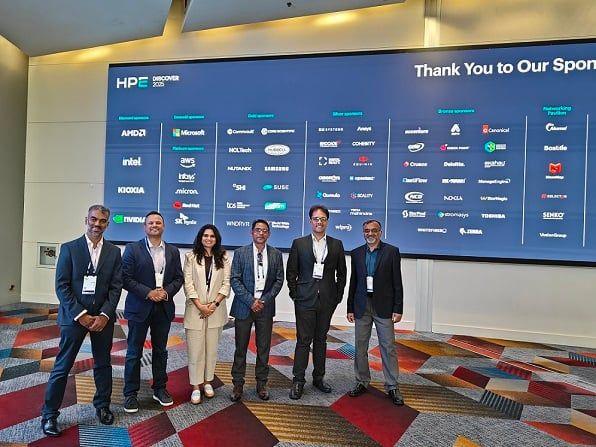
Leading AI-Native Engineering: Key Glimpses from HPE Discover 2025

Mega. Magnetic. Monumental.That’s how we’d describe HPE Discover 2025—a spectacle of scale, smarts, and synergy. Held in the vibrant heart of Las Vegas, the event wasn’t just a tech conference. It was a living pulse of innovation, a place where thousands of technology leaders, futurists, engineers, and enterprises came together to shape what’s next.And Aziro was right there in the thick of it.For Aziro, HPE Discover 2025 wasn’t just another event—it marked our bold debut under a brand-new identity. New name, new booth, new energy. Aziro took the floor with intent: to connect, to co-create, and to champion a new era of AI-native engineering. The Journey to LA: Flight. Focus. Future.Every event begins well before the booth goes live—it starts with anticipation. As we boarded our flight to LA, our team carried more than just gear and gadgets; we had ambition. Together, we mapped out our outreach strategies and refined our AI-native pitch, energized and united in our mission. Excitement buzzed through us all, fueled by the knowledge that we were advancing toward the future of engineering, driven by intelligence and intention.The Aziro Booth: Bold. Beautiful. Branded.HPE Discover 2025’s floor was buzzing with energy, but our eyes were locked on one thing: the Aziro #3245 booth. We couldn’t take our eyes off the AI-themed structure, glowing in muted lights, sleek panels, and a brand-new name that made its presence felt.Immersion: The Grand SetupHPE Discover isn’t just the crowd—it’s the canvas. High ceilings with dynamic projection maps, endless rows of interactive displays, and collaborative pods filled with people from over 30 countries. It felt less like an event and more like a global tech ecosystem stitched together by innovation.Tuesday Kickoff: Making it CountHPE Discover started on June 23rd, and from the first handshake to the last notebook scribble, we made it count. We listened. We asked more profound questions. We didn’t pitch products—we unpacked real challenges our prospects were facing. From a fintech firm seeking risk-aware automation to a healthcare company needing compliance-ready AI, we offered more than just slides: solutions and services with substance.The Aziro Arsenal: Our AI-Native StackWe showcased our full AI-native stack, each layer designed to meet the real-world needs of digital enterprises:AI-Enabled AutomationAgentic AI-Driven Business ProcessesAI-Driven DevSecOpsSRE and ObservabilityRAG-Enabled Support SystemsAI-Driven TestSmartEnhanced User ExperienceAI-Native CybersecurityThe Speakers: Voices of the FutureFrom Day 1, the speaker line-up was power-packed. Thought leaders, tech CEOs, and public sector visionaries—all talking about the next big leaps. We had a detailed chat with Christine De Nardo, COO at the Olivia Newton-John Cancer Research Institute. Her interest in AI-powered research diagnostics and data-driven care led to a powerful brainstorming session on what could become a healthcare PoC. Beyond keynotes, the speaker lounges turned into think tanks. And we were right there, exchanging ideas with the best.Relationships > Booth VisitsWe built many real connections during the event. We hosted whiteboard sessions, reverse-pitched on-the-spot challenges, and opened doors to co-development. Our conversations were tailored, profound, and often surprising.Final Word: From Presence to PurposeIn the world today, when everyone just talks about AI, very few are engineering it for absolute scale, absolute velocity, and real outcomes.Aziro is one of those few.Aziro enables businesses to embrace cognitive automation, reimagine their platforms, and scale their software products from early-stage innovation to IPO-level readiness. Its new brand language underscores agility, innovation, and a deep passion for problem-solving — values that have long been part of its culture.“Aziro is our statement of intent, of who we are, what we solve, and how we show up for our clients,” said Sameer Danave, Senior Director – Marketing at Aziro.HPE Discover event deeply strengthened our identity as an AI-native, innovation-led transformation partner, built to tackle today’s enterprise challenges and design tomorrow’s opportunities. This is not just a name change; it is a bold elevation of our promise.If you met us at HPE Discover, we are pleased to reconnect with you. If you missed us, let’s still connect.Because the future is AI-native, and Aziro is already building it.

Aziro Marketing

blogImage

No Time for Downtime: 5-point Google Cloud DevOps Services Observability

Even with the greatest DevOps resources in place, a misalignment with new technologies and customer expectations may be disastrous for an organization. Downtime is not only a nasty word in the IT sector, but it is also a very expensive one. As organizational objectives shift and the need for additional services to satisfy consumer demands grows, IT teams are obliged to deploy apps that are more contemporary and nuanced. Unfortunately, recent outage incidents for services ranging from airline reservation systems to streaming video to e-commerce have resulted in loss of millions of dollars and endless hours of work. Cloud tools were also disrupted, causing numerous third-party services to fail and greatly impeding corporate operations that rely on them. Consequently, it is imperative for the DevOps teams to ensure top-notch measures for zero-downtime and outages while achieving the cultural and technical prowess they work relentlessly for. Google Cloud DevOps Services have the necessary tools and resources that emphasizes the need to monitor underlying architecture and foundation of a DevOps system. While a lot of contemporary DevOps services fail to deliver the desired performance quality for code scanners, pipeline orchestration, and even IDEs Google DevOps services might offer the require frameworks seek and root out the single points of failure for IaaS/SaaS services. So, let us take a look at some of the prime monitoring and self-healing features of Google Cloud DevOps that can help with ensuring uninterrupted service performance. Google DevOps Monitoring and Observability Google DevOps services understand the role of Monitoring for high-performing DevOps teams. Comprehensive Monitoring can make the CI/CD pipeline more resilient to unforeseen incidents of outages and downtime. For the DevOps team to assist in managing the rising complexity of automating optimal infrastructure, integration, testing, packaging, and cloud deployment it is essential that the observability and Monitoring is taken seriously. Here’s some idea about how Google DevOps ensure the required monitoring and observability standards: Infrastructure monitoring: The infrastructures are monitored for any indicators related to data centers, networks, hardware, and software that might be showing signs of service degradation. Application monitoring: Along with the application health in terms of availability and performance speed, Google DevOps resources also observe the performance capacity and unexpected behaviors by the application to predict any future downtime scenarios Network monitoring: Networks can be prone to unauthorized access and unforeseen activities. Therefore, the monitoring resources are invested in access logs and undesirable network behaviors like traffic, scalability etc. Systematic Observation Google DevOps takes a rather sophisticated approach to ensure impeccable Monitoring and observability. This can be understood with 5 specific points: Blackbox Monitoring: A sampling-based approach is employed to monitor particular target areas for different users or APIs. Usually blackbox monitoring is supported by a scheduling system and a validation engine that ensure regular sampling and response checks. Whitebox Monitoring: Unlike Blackbox monitoring, this one doesn’t only deal with response check. It goes deeper to observe more intricate points of interests – Logs, Metrics, and Traces. This gives a better understanding regarding the system state, thread performance, and event spans. Instrumentation: Instrumentation is concerned with the inner state of the system. Log entries and event spans with varying gauges can be observed to get detailed data about the systems states and behavioral characteristics. Correlation: Correlation essentially takes in the different data and puts them together to see a single pattern that can connect the different data points to present the report on the fundamental behavior and requirements of the system Computation: Finally, the points of correlation are aggregated for their cardinality and dimensionality that would give the precise report for the real-time dynamic functioning of the system and the related metadata to work on it. Therefore, with these 5 points of observability, Google Cloud DevOps Services make sure that the system is monitored through-and-through to eliminate any possible outages scenarios in future. Conclusion We can all agree that decreasing downtime while lowering costs is critical for any organization, thus bringing on a DevOps team to drive innovation should be a top priority for every company. IT outages are unaffordable for businesses. Instead, they must guarantee that a solid DevOps foundation is established, and that their goals are matched with those of IT departments in order to complete tasks quickly and efficiently while reducing the chance of failure. Downtime is no longer only an IT issue, it is now a matter of customer service and brand reputation. Investing in skills and technologies to limit the possibility of downtime in today’s app-centric, cloud-based world is money well spent.

Aziro Marketing

EXPLORE ALL TAGS
2019 dockercon
Advanced analytics
Agentic AI
agile
AI
AI ML
AIOps
Amazon Aws
Amazon EC2
Analytics
Analytics tools
AndroidThings
Anomaly Detection
Anomaly monitor
Ansible Test Automation
apache
apache8
Apache Spark RDD
app containerization
application containerization
applications
Application Security
application testing
artificial intelligence
asynchronous replication
automate
automation
automation testing
Autonomous Storage
AWS Lambda
Aziro
Aziro Technologies
big data
Big Data Analytics
big data pipeline
Big Data QA
Big Data Tester
Big Data Testing
bitcoin
blockchain
blog
bluetooth
buildroot
business intelligence
busybox
chef
ci/cd
CI/CD security
cloud
Cloud Analytics
cloud computing
Cloud Cost Optimization
cloud devops
Cloud Infrastructure
Cloud Interoperability
Cloud Native Solution
Cloud Security
cloudstack
cloud storage
Cloud Storage Data
Cloud Storage Security
Codeless Automation
Cognitive analytics
Configuration Management
connected homes
container
Containers
container world 2019
container world conference
continuous-delivery
continuous deployment
continuous integration
Coronavirus
Covid-19
cryptocurrency
cyber security
data-analytics
data backup and recovery
datacenter
data protection
data replication
data-security
data-storage
deep learning
demo
Descriptive analytics
Descriptive analytics tools
development
devops
devops agile
devops automation
DEVOPS CERTIFICATION
devops monitoring
DevOps QA
DevOps Security
DevOps testing
DevSecOps
Digital Transformation
disaster recovery
DMA
docker
dockercon
dockercon 2019
dockercon 2019 san francisco
dockercon usa 2019
docker swarm
DRaaS
edge computing
Embedded AI
embedded-systems
end-to-end-test-automation
FaaS
finance
fintech
FIrebase
flash memory
flash memory summit
FMS2017
GDPR faqs
Glass-Box AI
golang
GraphQL
graphql vs rest
gui testing
habitat
hadoop
hardware-providers
healthcare
Heartfullness
High Performance Computing
Holistic Life
HPC
Hybrid-Cloud
hyper-converged
hyper-v
IaaS
IaaS Security
icinga
icinga for monitoring
Image Recognition 2024
infographic
InSpec
internet-of-things
investing
iot
iot application
iot testing
java 8 streams
javascript
jenkins
KubeCon
kubernetes
kubernetesday
kubernetesday bangalore
libstorage
linux
litecoin
log analytics
Log mining
Low-Code
Low-Code No-Code Platforms
Loyalty
machine-learning
Meditation
Microservices
migration
Mindfulness
ML
mobile-application-testing
mobile-automation-testing
monitoring tools
Mutli-Cloud
network
network file storage
new features
NFS
NVMe
NVMEof
NVMes
Online Education
opensource
openstack
opscode-2
OSS
others
Paas
PDLC
Positivty
predictive analytics
Predictive analytics tools
prescriptive analysis
private-cloud
product sustenance
programming language
public cloud
qa
qa automation
quality-assurance
Rapid Application Development
raspberry pi
RDMA
real time analytics
realtime analytics platforms
Real-time data analytics
Recovery
Recovery as a service
recovery as service
Retail
rsa
rsa 2019
rsa 2019 san francisco
rsac 2018
rsa conference
rsa conference 2019
rsa usa 2019
SaaS Security
san francisco
SDC India 2019
SDDC
security
Security Monitoring
Selenium Test Automation
selenium testng
serverless
Serverless Computing
Site Reliability Engineering
smart homes
smart mirror
SNIA
snia india 2019
SNIA SDC 2019
SNIA SDC INDIA
SNIA SDC USA
software
software defined storage
software-testing
software testing trends
software testing trends 2019
SRE
STaaS
storage
storage events
storage replication
Storage Trends 2018
storage virtualization
support
Synchronous Replication
technology
tech support
test-automation
Testing
testing automation tools
thought leadership articles
trends
tutorials
ui automation testing
ui testing
ui testing automation
vCenter Operations Manager
vCOPS
virtualization
VMware
vmworld
VMworld 2019
vmworld 2019 san francisco
VMworld 2019 US
vROM
Web Automation Testing
web test automation
WFH

Real People, Real Replies.

That's how it usually goes, you reach out with a question or a rough idea, a real person at Aziro responds, and a conversation turns into something big.
Start yours with us.

Phone

Talk to us

+1 227 232 3176

Email

Drop us a line at

info@aziro.com

Got a Tech Challenge? Let’s Talk

Country code

Got a Tech Challenge? Let’s Talk

Country code