CAWi: What We Are Building and Why It Matters for Enterprise AI

CAWi: What We Are Building and Why It Matters for Enterprise AI

Aziro Marketing

|

06 Sept 2026

Every enterprise today can point to an AI pilot. Fewer can point to an AI system their teams reach for every day. Somewhere between the demo and the desk, most enterprise AI stalls out, not because the model isn't capable, but because it never actually meets the enterprise where it lives, scattered across a dozen systems, locked behind permissions, and buried in tools that were never built to talk to each other.

CAWI Main Image.png

That gap is what we set out to close with CAWi, Aziro's homegrown AI orchestrator. This isn't another chat interface bolted onto a search bar. It's an attempt to answer a much harder question: what does it take for AI to become a trustworthy, everyday layer inside a real enterprise, not just a clever demo inside one?Ā 

The Silo Problem Isn't a Data Problem

Most conversations about enterprise AI readiness start with data quality. Ours starts somewhere else: data location. The typical enterprise doesn't have a shortage of information. It has an overabundance of it, spread across email, CRM systems, internal wikis, collaboration platforms, and dozens of niche applications that each hold a piece of the picture no one else can see.

The knowledge exists. It's the connective tissue that's missing.

This is why so many AI rollouts underdeliver. You can give an employee an extremely capable model, but if that model can't see the ticket in Jira, the code in GitHub, and the thread in Outlook at the same time, it's answering with one eye closed. The employee still must do the real work: hunting across systems, piecing together context, and manually feeding it all back into the AI just to get a useful answer.

ā€œYour teams use Jira. Your developers live in GitHub. Your executives work out of Outlook. And none of them talk to each other.ā€

That line has become something of an internal mantra for us, because it's the honest starting point for almost every enterprise we talk to. The tools aren't the problem. The silence between them is.Ā 

What We're Building: One Assistant, Every System

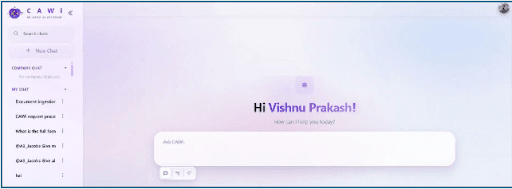
CAWi's core premise is simple to state and hard to build enterprise data shouldn't need to be duplicated, exported, or migrated into a new system just so AI can use it. It should be connected, in place, under the organization's own governance.

Cawi Image 2.png

That means CAWi doesn't ask a company to rebuild its stack around a new tool. It sits across the tools the company already has, ingesting context from wherever that context already lives, and giving employees one place to ask a question and one place to get it acted on. A single assistant, spanning every connected system, instead of five browser tabs and a mental map of where each answer might be hiding.

This matters more than it sounds like it should. Every additional system an employee must check is a small tax on their time and a small increase in the odds they miss something important. Multiply that across a workforce, and ā€œsearch five systems to find one answerā€ becomes one of the largest hidden costs in a modern enterprise, one that rarely shows up on a balance sheet but shows up everywhere in how slowly decisions get made.

From Keyword Search to Understanding

The second problem CAWi is built to solve is more subtle, but just as costly: enterprise search has never really worked the way people think it does.

CAWI Image 3.png

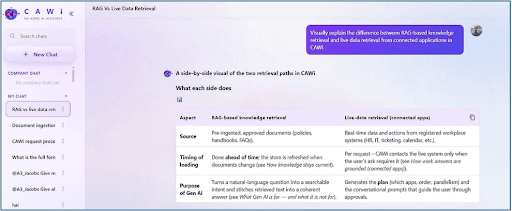
Traditional enterprise search is keyword matching wearing a search bar's clothing. It rewards people who happen to remember the exact phrase used in a document, and it punishes everyone else, which in practice means most people. You know the answer exists somewhere in the company's knowledge base. You just can't find it, because you didn't guess the right five words.

CAWi is built to search by meaning instead of syntax, across documents, policies, and project files, without requiring a person to know exactly how something was worded, or where it was filed. That's a small-sounding shift with a large practical effect: it turns ā€œI think we have documentation on this somewhereā€ into an actual answer, in seconds, instead of a ticket to IT or a message to whoever's been at the company the longest.Ā 

Why Security Cannot Be an Afterthought

None of these matters if it comes at the cost of an enterprise's control over its own data, and this is where we've been most deliberate.

Enterprise AI adoption almost always runs into the same wall in the boardroom: where does our data go once, we plug it into this? It's a fair question, and for a lot of AI tooling on the market today, the honest answer is unsatisfying. Data gets sent out, processed elsewhere, and returned, and the enterprise is left trusting a third party's promises about what happened to it along the way.

We built CAWi to make that question easy to answer. CAWi runs entirely within an organization's own infrastructure. Nothing leaves the environment to get processed, not even to us. Role-based access control, PII detection and masking, and a zero-trust architecture aren't optional add-ons here; they're the foundation the rest of the system is built on.

ā€œCAWi runs entirely within your infrastructure. No data egress, no external inference calls, no hidden pipeline to a third party. Not even to us.ā€

We think this is going to matter more, not less, as enterprise AI matures. The first wave of adoption was driven by curiosity: what can this do? The next wave will be driven by scrutiny: what is this doing with our data while it does it? Systems that can't answer that question clearly are going to lose ground to systems that can, especially in regulated or security-conscious industries where ā€œtrust usā€ was never going to be enough.Ā 

Why This Matters Beyond CAWi

We're not building CAWi because we think every enterprise needs another dashboard. We're building it because we think the current framing of ā€œenterprise AIā€ is too narrow. Most of the industry has optimized for how smart the model is. We think the harder, more valuable problem is how connected, how governed, and how genuinely usable that intelligence is once it's inside a real organization, with real systems, real permissions, and real people who don't have time to learn a new tool just to ask a question they already know the answer exists for somewhere.

That's the bet behind CAWi, that the next real gain in enterprise AI won't come from a smarter model alone. It will come from finally giving that model a legitimate, secure way to see the whole enterprise at once, and giving employees one place to ask, one place to act, and one system they can trust with the answer.Ā 

The model was never the hard part. The enterprise was.Ā 

Real People, Real Replies.

That's how it usually goes, you reach out with a question or a rough idea, a real person at Aziro responds, and a conversation turns into something big.
Start yours with us.

Phone

Talk to us

+1 227 232 3176

Email

Drop us a line at

info@aziro.com

Got a Tech Challenge? Let’s Talk

Country code

Got a Tech Challenge? Let’s Talk

Country code